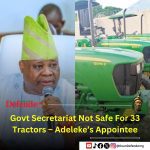
Outrage As Farmers Await FG’s Tractors 69 Days After Launch – Report



There was a reported outrage among farmers’ groups over the non-distribution of the 2,000 tractors and other implements for mechanised farming, sixty-nine days after the federal government launched the initiative.
The President Bola Tinubu administration had ordered the direct purchase of 2,000 tractors.
The tractors and other implements were procured to increase farm mechanisation drive, in what was touted as part of the moves by the Tinubu administration’s Renewed Hope Agenda to reduce food inflation, increase food production and reduce foreign currency expenditure.
The president, while launching the 2,000 tractors on June 24, 2025, had said they would be distributed nationwide through a service-provider model to support small-holder farmers with access to modern equipment, reduce manual labour, and increase yields.
However, findings by Daily Trust indicated that the tractors and the implements had not been delivered to farmers.
A Daily Trust correspondent who visited the National Agriculture Seed Council at Sheda, Kwali Area Council in Abuja, where the tractors were commissioned, observed that they were still stored there.
While farmers pleaded for the immediate release of the tractors and other implements, highly placed government officials told Daily Trust that there was no directive yet from the Presidency for distribution.
Speaking to Daily Trust, the president of the All Farmers Association of Nigeria (AFAN), Architect Kabiru Ibrahim, said the association was surprised that the equipment were yet to be distributed.
“Farmers are as surprised as everybody else that the 2,000 tractors and other farm machinery launched by Mr President have not been distributed yet.
“While we await the modalities of distributing these items, we plead with the administration to distribute them equitably and as soon as possible.
“The year 2025 is the year that we thought was going to be the veritable litmus test of the state of emergency on food security when the tractors were launched, but it is still work in progress,” he said.
Ibrahim said the tractors should be distributed to clusters of small-holder farmers because “no small farmer can buy a tractor now.”
“The most effective distribution system will be achieved by choosing or identifying areas of need and allocating the tractors to determined groups of small holder farmers to lease or use free of charge.
“The 2,000 tractors should be given to each state on need basis in the first instance and offered for hire service to any farmer who needs the service in the last analysis,” he added.
Olamilekan Adigun is a graduate of Mass Communication with years of experience in journalism embedded in uncovering human interest stories. He also prioritises accuracy and factual reportage of issues.