- Genocide Not Isolated – Muslim Leaders
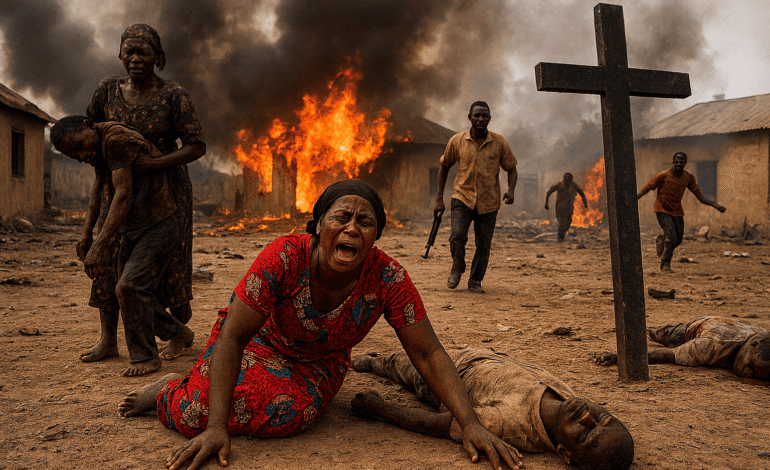
Christian leaders over the weekend reaffirmed their claim that Christians are facing what they described as a deliberate genocide in several parts of the country.
They said persistent killings in Plateau, Benue, Kaduna, Taraba and Borno show a pattern the government has failed to stop.
President of the Pentecostal Fellowship of Nigeria, Bishop Francis Wale Oke, said the word “genocide” reflects the scale of violence.
He said many communities have been repeatedly attacked without arrest or deterrence.
According to him, milder descriptions have not moved the government to act.
The Christian Association of Nigeria President, Archbishop Daniel Okoh, also faulted government responses, saying repeated denials have trivialised the experiences of victims.
Other CAN officials said church records show more than 4,300 Christian deaths in 2023 and over 2,800 recorded this year.
Catholic Bishop of Sokoto, Matthew Hassan Kukah, said the term genocide matches the reality in some locations.
He noted that the state has lost capacity to protect citizens and that security failures have allowed violence to escalate.
Muslim leaders, however, disagreed with the genocide label.
The Supreme Council for Islamic Affairs said the violence affects both faiths and warned that framing it as one-sided could heighten tension.
The body noted that thousands of Muslims have also been killed in the North-West and North-East.
Despite this, Muslim groups also criticised the government’s handling of security.
They said the state has been unable to curb armed groups and that many communities remain unsafe regardless of religion.
Minister of Information, Mohammed Idris, rejected the genocide claims, calling them false and divisive.
He said terrorists attack both Muslims and Christians and insisted the government has recorded major security gains.
The Chief of Defence Staff, General Olufemi Oluyede, also denied any targeted persecution.
Civil society groups countered that official claims do not reflect realities in rural areas, where attacks continue frequently. They argue that government announcements are not translating into improved protection for vulnerable communities.
International rights groups have expressed concern over Nigeria’s rising death toll.
Some say displacement patterns in the Middle Belt resemble targeted attacks, while others fault Abuja for slow and inconsistent responses.
The Christian leaders said they will maintain the genocide description until the government provides measurable action.
They called for independent investigations, transparent casualty data and stronger security deployment in affected states.

Kazeem Badmus is a graduate of Mass Communication with years of experience. A professional in journalism and media writing, Kazeem prioritses accuracy and factual reportage of issues. He is also a dexterous finder of the truth with conscious delivery of unbiased and development oriented stories.