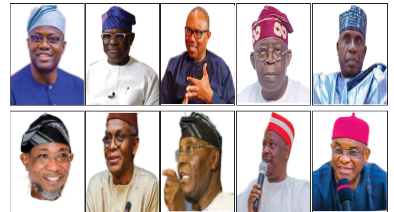
- Atiku, Makinde, Amaechi, El-Rufai, Others Race To Pick Presidential Tickets In PDP, ADC
- Three-Horse Race In Osun As Adeleke Rallies Opposition Stakeholders
The year 2026 is just a few days away. To many, it is another year but to key political watchers in Nigeria, it is one loaded with varied events. This is because it is one that precedes the much talked about 2027 general elections, where politicians will once again test their popularity and pact with the people of their various constituencies, states and the entire federation.
In this report, OSUN DEFENDER examines the road to 2027 and how the upcoming year will be highly definitive to the journey ahead.
- Atiku, Makinde, Amaechi, El-Rufai, Others Race To Pick Presidential Tickets In PDP, ADC
2027 will be the eight in the cycle of elections since Nigeria began its fourth republic in 1999. It is a year that will produce a new set of Governors for at least a half of the states of the federation, while many incumbents will return. President Bola Tinubu will also vie for a constitutionally backed second term in office.
Across party lines, consultations, quiet meetings and strategic realignments kicked off earlier than usual in early 2024. In fact, the race for the nation’s top job, began late in 2023 with the emergence of key elements across the country joining forces to institute a grand coalition that will seek to wrestle power from the ruling All Progressives Congress (APC).
The African Democratic Congress (ADC) had in July this year emerged as the alternative platform for leading opposition voices in the country, particularly after their bid to register a new party was ‘frustrated.’
OSUN DEFENDER gathered that the tendency led by former Senate President David Mark and former Governor of Osun, Ogbeni Rauf Aregbesola, as National Secretary, was predicated on the desire to promote responsible leadership, restore public confidence in governance, and as well tackle the myriad of governance challenges facing the most populous black nation.
Major leaders in the opposition tendency, including former Vice President Atiku Abubakar, Labour party’s Presidential candidate, Peter Obi, Mallam Nasir El-Rufai, Rotimi Amaechi, among others are seen by many as those likely to contest the party’s ticket. While Atiku has opened up on his desire to vie for the nation’s top job once again, figures like El-Rufai, Amaechi, and others within the ADC are also predicted to be interested in representing the party at the polls.
With the renewed calls for a Southern presidential candidate, some gladiators may finally decide to step down for each other in order to win the election. Currently, the ruling APC at the centre has 27 state governors, with some others on the waiting list and may defect before the end of 2026 Q1.
Beyond the ADC, hitherto main opposition Peoples Democratic Party (PDP) is still grappling with the internal crisis that has plagued it since the last general elections. While FCT Minister Nyesom Wike insists on his lackeys being at the helms of affairs, Oyo State Governor Seyi Makinde has not relented in taking over the leadership of the party.
While issues related to the recent Ibadan PDP National Convention are yet to kiss the dust, Makinde remains the favourite to clinch the party’s presidential ticket, if the rotational presidency that currently gives the South an edge is followed.
The outgoing Governor of Oyo brings to the race a blend of a corporate experience and an eight-year reign as the Chief Executive of the pacesetter state, as well as his deep pocket, which many see as his strength going into the race.
The year 2026 will unfold some other contenders, pretenders and those who may wish to test the waters ahead of 2031.
- Three-Horse Race In Osun As Adeleke Rallies Opposition Stakeholders
With the conclusion of party primaries on December 15, the stage is set for a breathtaking campaign period, as citizens and residents of Osun State edge closer to the much anticipated August 8, 2026 governorship election.
Although, there seems to be four major contenders for the Bola Ige House, OSUN DEFENDER’s findings indicated that only the candidates of Accord – Governor Ademola Adeleke; All Progressives Congress (APC) – Mr. Bola Oyebamiji and that of the African Democratic Congress (ADC) – Dr. Najeem Salaam are the major frontrunners, while the candidature of Adedamola Adebayo (Fryo) of the Peoples’ Democratic Party (PDP) may be disputed.
Many stakeholders are interested in the potential outcome of the Osun election due to various factors. Top on it is the fact that the election precedes the national one; which has for three consecutive cycles shown the pattern and tendency that elections have gone on the bigger scale across the country, especially at the Presidential Race.
The other angle to it is that the top three contenders come from the same Osun West Senatorial District, which has for long yearned for the governorship of the state. While people like Oyebamiji – the immediate past Managing Director of the National Inland Waterways Authority (NIWA), enjoy the backing and support of the federal government, Salaam – a former Speaker of Osun State House of Assembly counts on public support and the achievements of his leader, former Governor Rauf Aregbesola, who ruled the state from 2010=2018.
On the flip side, Adeleke’s political journey since 2022 illustrates the difficulty of survival in a fluid environment. Despite sustained speculation, the Governor found it difficult to secure a seamless transition into the APC. Internal resistance, factional interests, and unresolved rivalries limited his options.
With those doors effectively shut, Adeleke has now aligned with the Accord Party, a move driven by strategic necessity rather than sentiment. Since then, his political activity has intensified. He has stepped up engagements with former key figures, especially his recent romance with former Secretary to the State Government, Alhaji Moshood Adeoti, who left the Omoluabi Progressives camp, a few weeks ago.
Reports also suggest that the Governor his making silent moves to woo key leaders of the Aregbesola tendency, to midwife a possible coalition against the All Progressives Congress (APC) spearheaded by former Governor Gboyega Oyetola now Minister of Marine and Blue Economy.
- Ekiti 2026: Oyebanji, Bejide, Oluyede Weigh Chances
As Ekiti State prepares for the June 20, 2026 governorship election, three major political parties have unveiled their candidates, signalling the start of an intensely competitive race. The incumbent governor, Biodun Oyebanji, will contest on the platform of the ruling All Progressives Congress (APC), seeking a second term in office. The Peoples Democratic Party (PDP) has presented Dr Wole Oluyede, a familiar figure who has previously contested the governorship twice, while the African Democratic Congress (ADC) has nominated Ambassador Dare Bejide for its first major governorship outing in the state.
Ekiti’s political landscape has historically been shaped by the rivalry between the APC and the PDP since the return to democratic rule, and this pattern is expected to continue in 2026.
However, the entry of the ADC adds a new dimension, as the party seeks to expand its influence and challenge the dominance of the two established parties. While the APC and PDP retain deep-rooted structures across the state, the ADC is positioning itself as an alternative voice in the contest.
Political analysts say the APC enters the race with clear advantages, including incumbency, access to resources, and strong party structures. The ruling party is expected to campaign on its governance record, infrastructure projects, and the promise of continuity, with support from key political figures and stakeholders in the state strengthening Governor Oyebanji’s re-election bid.
The PDP, on the other hand, faces internal challenges that could affect its prospects. Despite its loyal grassroots base, the party is grappling with divisions, including a legal dispute arising from its last governorship primary that produced Dr. Oluyede as candidate. Observers note that how effectively the PDP resolves these issues, alongside the ADC’s ability to mobilise voters beyond its current base, will play a critical role in shaping the outcome of the 2026 election.
These moves suggest deliberate efforts to build a broad opposition front capable of challenging APC dominance in the state.
- The Pulse Of The People
Across Osogbo, Ilesa, Ede, and other urban centres, voter attitudes show growing scepticism toward party switching. From available data, many voters now evaluate candidates based on performance data, budgets and visible projects delivered since 2022.
Social media analysis since 2023 highlights declining emotional attachment to big parties, especially among first-time voters. Undecided voters now form a significant bloc in several wards, creating uncertainty for all camps.
Economic pressure, insecurity, and governance delivery remain the top issues shaping voter conversations.
- Looking Ahead To 2026
As 2026 approaches, party tickets will increasingly be determined by numbers, structures, and turnout potential. APC’s control of most governorships gives it leverage, but voter fatigue presents risks.
Opposition success depends on unity, credible alternatives, and effective mobilisation. Osun State will serve as a critical test of whether new alliances can outperform entrenched power.
Nationally, ADC’s strategic choices may redefine third-force politics.
OSUN DEFENDER’s findings note that Nigerian politics in 2026 will reward those who understand data, timing, and public mood, not noise or nostalgia.

Sodiq Yusuf is a trained media practitioner and journalist with considerable years of experience in print, broadcast, and digital journalism. His interests cover a wide range of causes in politics, governance, sports, community development, and good governance.