PERSPECTIVE: When Power Distorts Principle: Historical Facts on Osun’s Modulated Salary Policy and the Politics of Denial


- By Wale Balogun
Sometimes, one is compelled to reflect on what makes people abandon a path, a principle, or an ideology they once defended.
Is it mere pecuniary interest, morbid ambition for power, the urge to settle personal scores, or a combination of all these? Too often, “truth and facts” are invoked not to illuminate reality, but to justify prejudice, standing truth on its head and endlessly rationalising illogical conclusions.
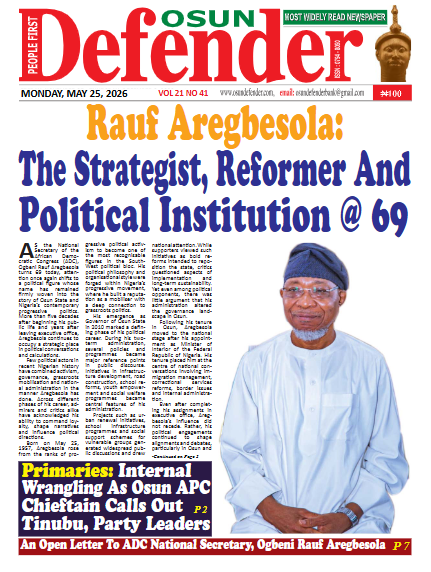
A clear illustration is the posture of the former governor of Osun State, Gboyega Oyetola, who has sought to distance himself from the modulated salary structure introduced during the tenure of Ogbeni Rauf Adesoji Aregbesola, despite being a central actor in that administration. His poster boy and APC governorship candidate, Bola Oyebamiji, now follows the same path of denial, even though he served as Commissioner for Finance in Osun State at the time.
Yes, the buck stops at the desk of Ogbeni Rauf Aregbesola, who accepted responsibility as the leader he was, and remains. As the August 8, 2026 Governorship election approaches, Osun electorate should not only distance themselves from, but decisively reject, Bola Oyebamiji, who speaks from both sides of the mouth due to political expediency and a desperation for power he cannot win in any free and fair contest. For his repeated denials, misrepresentations, and misplaced confidence in being rigged into office, the people of Osun must be mobilised to resist the lying, cancerous political character he represents.
In defence of facts and the re-establishment of historical truth, the following accurately captures what the Modulated Salary Policy under Ogbeni Aregbesola.
Overview: Modulated Salary Policy in Osun State (2015–2018)
Confronted with severe revenue shortfalls triggered by the 2014 global oil price crash, the Aregbesola administration introduced a modulated salary structure as a fiscal safeguard. The policy was designed to avoid mass retrenchment, manage the wage bill, and keep the civil service functional during an unprecedented economic downturn.
How the Modulated Salary Worked
Not all workers received reduced pay:
Levels 1–7 (≈67%): Paid 100% of salary
Levels 8–12 (≈25%): Paid 75% of salary
Levels 13–17 & political appointees (≈8%): Paid 50% of salary
Only about 28% of the workforce experienced salary reduction, not the entire workforce, as falsely claimed.
By July 2018, full salaries were restored across all categories following improvements in federal allocations.
Federal Allocation Constraints (June 2015 – July 2018)
Osun State’s revenue collapse was stark:
2015 (Jun–Dec): ₦40.42 billion
2016: ₦5.9 billion (peak of the crisis)
2017: ₦10.4 billion (modest recovery)
2018 (Jan–Jul): ₦12.4 billion (continued rebound)
Total (3 years): ≈₦45 billion, underscoring the depth of fiscal stress.
These figures debunk the myth that Osun enjoyed ample revenue but mismanaged it. The crisis was national and well documented.
Broader National Context: FAAC Disbursements (2015–2018)
2015: ₦6.011 trillion
2016: ₦5.1 trillion (sharp decline)
2017: ₦6.418 trillion
2018: ₦8 trillion
States received only 26.72% of FAAC allocations, severely limiting fiscal flexibility.
Addressing Misinformation: It is inaccurate to claim that “the entire workforce was paid half salary.” In reality, 72% of workers received full or near-full pay.
Claims that pensioners were abandoned or that state funds were squandered ignore:
The verifiable national revenue collapse. The deliberate choice to preserve jobs rather than sack workers. The eventual clearance of arrears as revenues improved. The real challenge was a national economic crisis, not local fiscal recklessness.
Conclusion
The Modulated Salary Policy was a pragmatic, temporary response to an extraordinary fiscal emergency. It: Prevented large-scale job losses Sustained government operations during severe economic strain.
Ogbeni Rauf Adesoji Aregbesola accepted responsibility for taking the only viable path available at the time. Available data and federal allocation figures clearly show that his administration navigated a national economic storm with difficult but responsible choices, contrary to the false narratives now being peddled for narrow political gain.
Against this backdrop, the attempts by Gboyega Oyetola and his anointed APC candidate (Imagine a governor whose administration failed woefully and was rejected for a second term, now having the effrontery to attempt to impose a governor through tyrannical federal might and a compromised INEC), Bola Oyebamiji, to disown a policy they midwifed and defended at the time amounts not to principled disagreement, but to the politics of denial.
- Balogun, a writer and analyst sent in this piece.
The opinions expressed in this publication are solely those of the author. It does not represent the editorial position or opinion of OSUN DEFENDER.
Related posts:
 Facts Behind The Figures On Modulated Salary Structure In Osun STRUCTURE IN OSUN
 How Oyetola Cleared Aregbesola Over Modulated Salary Controversy
 We Are Not Happy Paying Modulated Salary To Workers –Aregbesola
 2023: Atiku’s Emergence As PDP Candidate Violates Nigeria’s Power Rotation Principle — Tinubu