Gunman Who Killed Japan Ex-PM Sentenced to Life Imprisonment
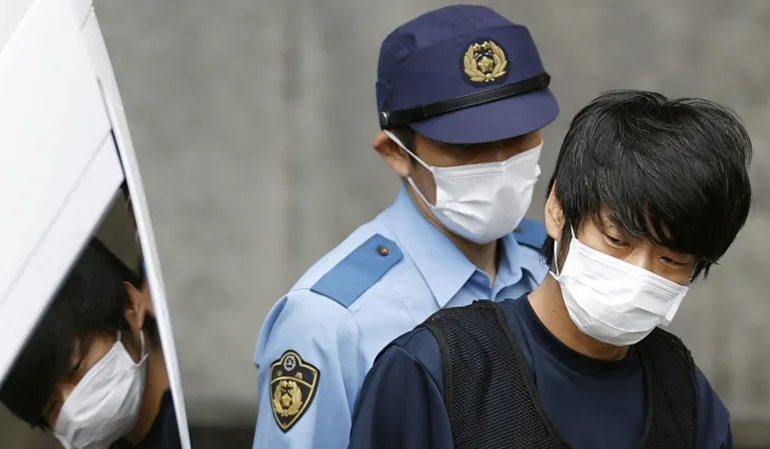


The man who assassinated Japan’s former prime minister, Shinzo Abe, has been found guilty and sentenced to life imprisonment, more than three years after the daylight shooting stunned Japan and the world.
A court in Nara on Wednesday convicted Tetsuya Yamagami, 45, of murder and firearms-related offences over the killing of Abe during a campaign speech in July 2022.
Handing down the sentence, Judge Shinichi Tanaka said Yamagami was “determined” to kill Abe.
The judge said shooting the former prime minister from behind when he least expected it showed the “despicable and extremely malicious” nature of the act.
Public interest in the case was intense, with long queues forming outside the courthouse early Wednesday for limited entry tickets.
Yamagami was charged with murder and violations of Japan’s firearms control laws after using a handmade gun to shoot Abe, Japan’s longest-serving prime minister.
At the opening of the trial in October, Yamagami admitted to murdering Abe but disputed some of the other charges, according to media reports.
Under Japan’s legal system, a trial proceeds even when a defendant pleads guilty.
Judge Tanaka said Abe’s death had “serious consequences” for society.
He added that Abe’s widow “still suffers from a significant sense of grief”.
Outside the court, Manabu Kawashima, a 31-year-old logistics worker, said he came to learn more about the killer.
“What happened to former Prime Minister Abe was the incident of the century. His death was shocking,” he told AFP.
“I wanted to know about the man who killed someone I cared about.”
Another man held a banner urging the court to consider Yamagami’s difficult life circumstances when delivering judgment.
Prosecutors said Yamagami’s motive was rooted in his hatred for the Unification Church.
They argued that he believed killing a high-profile figure like Abe would expose the church and spark public criticism.
During the trial, details emerged about how Yamagami’s mother made huge donations to the Unification Church, driving the family into bankruptcy.
Yamagami believed influential politicians were helping the church to thrive, prosecutors said.
Abe had previously spoken at events organised by groups linked to the church.
The Unification Church was founded in South Korea in 1954 and is often referred to as the “Moonies”, after its founder Sun Myung Moon.
Yamagami’s lawyers pleaded for leniency, saying his upbringing was marked by “religious abuse”.
They said his mother turned to the church after her husband’s suicide and her other son’s serious illness, donating assets worth about 100 million yen at the time.
As a result, Yamagami was forced to abandon plans for higher education.
In 2005, he attempted suicide, and his brother later also died by suicide.
Investigations following Abe’s assassination exposed widespread links between the Unification Church and conservative lawmakers in the ruling Liberal Democratic Party.
The revelations led to the resignation of four cabinet ministers.
Prosecutors said Yamagami began making a gun in 2020, carefully testing it in a remote mountainous area.
They said this showed the attack was highly premeditated.
The killing also shocked a nation with some of the world’s strictest gun control laws.
Gun crime is so rare in Japan that security officials initially failed to recognise the sound of the first shot, according to a police report.
Prosecutors described the murder as “unprecedented in our post-war history” and said it had “extremely serious consequences” for society.
Although life imprisonment in Japan allows for the possibility of parole, experts say many inmates die in custody.
AFP
Titilope Adako is a talented and intrepid journalist, dedicated to shedding light on the untold stories of Osun State and Nigeria. Through incisive reporting, she tackles a broad spectrum of topics, from politics and social justice to culture and entertainment, with a commitment to accuracy, empathy, and inspiring positive change.