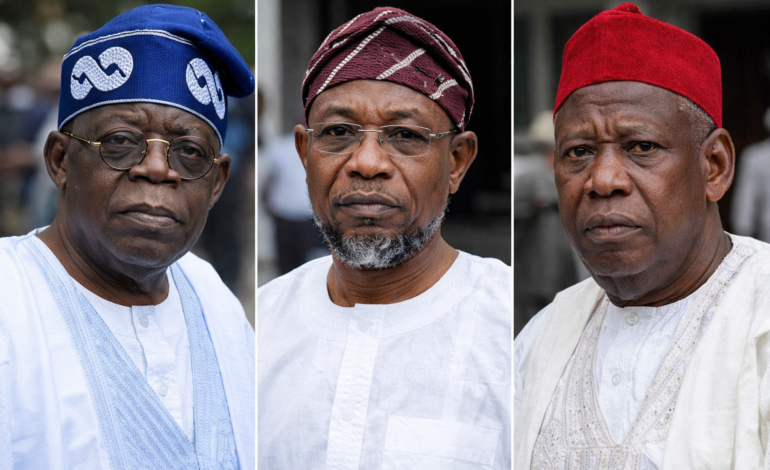

- Sanwo-Olu, Ganduje, Others Did Not Deliver For Tinubu Despite Incumbency
- Popular Votes, Not Govs Determine Electoral Success – Aregbesola
The 2023 general elections exposed major cracks in the long-held belief that Nigerian governors can automatically “deliver” their states to their parties in presidential contests.
Despite their control of state structures, resources and political machinery, a significant number of governors watched their states vote against their preferred presidential candidates.
OSUN DEFENDER reports that the 2023 elections were conducted in two phases, with presidential and National Assembly polls held on February 25, followed by governorship and state assembly elections on March 18.
While the governorship polls largely favoured incumbents and ruling parties at the state level, the presidential election told a different story.
President Bola Tinubu of the All Progressives Congress (APC) won the presidency with 8.79 million votes, but secured victories in only 12 states. In contrast, Peter Obi of the Labour Party (LP) won 11 states and the Federal Capital Territory, while Atiku Abubakar of the Peoples Democratic Party (PDP) also carried 12 states, reflecting a deeply fragmented political landscape.
Findings by OSUN DEFENDER revealed that in at least 19 states, governors failed to deliver their states to their party’s presidential candidate.
Results obtained from the Independent National Electoral Commission (INEC) showed that more than half of the country’s governors were unable to align state-level power with national electoral outcomes, particularly in the presidential race.
Some of the most striking examples occurred in APC-controlled states. In Lagos, despite Governor Babajide Sanwo-Olu’s firm grip on the state and the APC retaining the governorship, Peter Obi defeated Tinubu in the presidential poll, driven largely by youth mobilisation and urban dissatisfaction. The APC presidential candidate, for instance, lost his Ikeja Local Government to the Labour Party with 30,004 to his 21,276 votes.
Similar outcomes were recorded in Imo, Ebonyi, Plateau, Nasarawa, and Kano, where APC governors could not overcome regional sentiment internal party fractures, or strong local political movements.
PDP governors were not exempt. In Rivers, Governor Nyesom Wike’s dispute with the PDP leadership and his refusal to support Atiku Abubakar contributed to Obi’s presidential victory in the state. In Oyo, Governor Seyi Makinde won re-election comfortably, yet Tinubu carried the state in the presidential poll, underscoring the separation between local loyalty and national voting behaviour.
Furrher analysis by OSUN DEFENDER indicated that the Labour Party surge further weakened governors’ influence, particularly in the South-East, South-South, and parts of the North-Central.
Economic hardship and insecurity also played a role. In several northern states, voters punished ruling parties over fuel scarcity, inflation, naira redesign challenges, and persistent security crises, often disregarding the preferences of sitting governors.
- Popular Votes, Not Govs Determine Electoral Success – Aregbesola
Former Osun State governor and ex-Minister of Interior, Rauf Aregbesola, also captured this reality during the week when he argued that elections are won by the electorate, not governors.
Speaking on the state of party politics at an event in Abuja recently, Aregbesola warned political parties against overestimating the power of incumbency and underestimating voter agency, stressing that public sentiment now plays a greater role than elite directives.
His words, “I used the opportunity to remind the ruling APC that elections must be free and fair, because it is the people, not political power brokers, who should decide who wins.
“The 2023 elections taught us an important lesson: governors and other political bigwigs do not guarantee electoral victory. The APC’s presidential candidate was declared winner, yet he lost his ward, his local government, and his state. That alone tells us that controlling a state does not automatically translate into votes.
*In the Southwest, the APC governed all but one state, but still could not exceed 55 percent of the vote, with other parties sharing the rest. In the Southeast, the outcome was even more revealing, the APC managed just 5.8 percent of the total votes.
“The message is clear: elections are won by the people, not by governors. All we are asking of those in charge of the process is simple, commit to a free and fair election, and let the people’s choice speak for itself,” Aregbesola noted.
While the comments have continued to generate controversies, the 2023 experience showed that while governors remain powerful actors, their ability to impose presidential outcomes has weakened, challenged by voter awareness, technology, economic pressures, and grassroots movements.

Sodiq Yusuf is a trained media practitioner and journalist with considerable years of experience in print, broadcast, and digital journalism. His interests cover a wide range of causes in politics, governance, sports, community development, and good governance.