EDITORIAL: Getting Curiouser And Curiouser…!
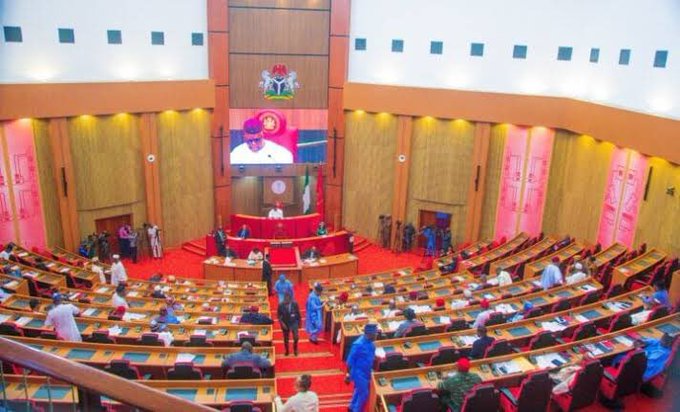


- A Tragic-comic Interlude in Nigeria’s Senate
SENATOR Sunday Steve Karimi who represents Kogi West in the Senate of the Federal Republic of Nigeria was born on the 10th day of March,1962.Which means that he was four years old when the putsch (debatable whether he was a coup d’tat) occurred on the 15th of January 1966.
On that day, the 1963 Republican Constitution was “suspended”. It is important to state that the 1963 constitution has been endorsed with a plebiscite confirming its legitimacy. The turnout during the referendum on the 1963 constitution was 82 percent of registered voters the highest before or since in any election in Nigeria electoral history dating back to the first legislative council election in the Lagos colony and calabar in1923.
It had popular endorsement and legitimacy. Senator Kadiri was one year old when the referendum took place. He can be forgiven for not knowing a great deal about the event which occurred at that time.
Senator Kadiri was obviously too young to have examined the merit of a proper operating federal set up. If he had, he would have seen the dangers entailed in further reinforcing the debilitating framework of a quasi-federalism which has constituted a stumbling block to the country’s development.
Confirming a theatre of the absurd, Senator Sunday Kadiri has moved a bill to increase the revenue allocated to the federal government.
According to a newspaper report, “The Senate on Tuesday initiated legislative steps to amend relevant provisions of the 1999 constitution to enable an upward review of the revenue allocation formula in favour of the Federal Government. Under the existing formula, the Federal Government receives 52.68 per cent of federally collected revenue, while the 36 states share 26.72 per cent and the 774 local government councils receive 20.60 percent”
The report summarises what is going to turn out to be a very terrible blow to the quest for sustainable development in Nigeria. That the bill passed the first reading so quickly reinforces the notion that the legislative body is anti-federalist and pays scant attention to the implications of what it is about to embark upon.
Already, the evidence is that the National Assembly is not thorough in scrutinising the present allocations to the federal government, and the oversight function of the National Assembly on the present allocations to the Federal Government.
The Assembly is often distracted by wallowing in trivia such as the suspension of a fellow member rather than paying rigorous attention to details and has refused to set up a very much needed Congressional Budgets Office to provide the much needed technical support to undertake rigorous scrutiny work. For this reason,We are in a very sorry state.
Senator Sunday Steve Kadiri obviously has no interest in the costs structure of governance even under what he considers to be the present inadequate allocations to the Central Government.
The senator is obviously not perturbed about the refusal to implement the recommendations of the Oronsaye report on the costs of machinery of the Federal Government.
Recurrent Expenditure continues to go up without any scrutiny of wasteful spending. The Assembly merrily continues to create new agencies and departments without doing any cost-benefit analysis as to their necessity. Surprisingly, debt has been incurred in order to service unproductive recurrent expenditure which have not translated into any value.
The country, as a result also landscaped with what in Nigeria will haplessly describe as “Abandoned Project”. In contradistinction, vitally needed funds are not available to beef up strategic areas such as the Armed Forces. The internal security mechanism, Health Education and Social Services. All of these show a dysfunction in thinking and in practice. There is absolutely no rational reason to increase any allocation without a forensic introspection about the costs and efficacy ratio.
The country has gained nothing from increased allocations to the centre, and people in positions of responsibility should be introspective and learned from the lessons of history; they will confirm the observation made by Marx that “History repeats itself twice, the first time as tragedy, the second time as farce.”
The tragedy of contemporary Nigeria is pronounced; we have about 139 million people in what is described as multidimensional poverty. The figure might actually be an underestimate. The grotesque underperformance to where accustomed likely to continue and possibly increase if the formula is changed to favour even more the central government.
The development process starts from the grassroots and then moves upward. Countries such as India, which have made giant strides have started from the base level. The community effort begins with the development of the human being with the provision of water systems, primary health facilities, primary education, environmental facilities, dissertation of land tittles to allow people to gain access to credit in order to modernise agriculture and so forth. It then moves upward. This is simple common sense. The community levels must be beefed up through increased allocations and upgraded technical assistance.
Let us take a brief look at how proper Federalism should work, as it did work in Nigeria under the Lyttleton constitution and the 1960 and 1963 constitution which operated under the framework of production as opposed to the rent-seeking framework of today. In the United States of America, for example, the State of California sends $500 billion to the federal government every year and still has $800 billion in reserve. This is real Federalism!
In India, the regional governments are the drivers of economic progress; a factor which has led to India becoming the fifth largest economy in the world and it is projected to become the largest economy in the world in 25 years’ time. Contrary to the delusions of grandeur propelling some people, real development starts from the grassroots.
The projected increase in revenue allocation, the recent proposal to increase the revenue allocated to the central government, is ill-advised; it goes against the empirical evidence amassed over the last century about the factors that trigger the development process.
The mindset propelling the continuation of a rent-seeking economy is reflected in this ill-fated bill. For the sake of this country, that anti-development mindset must be discarded.