EDITORIAL: Fear and Loathing in South Africa and Nigeria


Across the African continent, there is indeed a “natural mystic blowing through the air.” The rising wave of xenophobic tensions in South Africa is not an isolated crisis confined to the post-apartheid state. Rather, it reflects a broader continental failure of the post-colonial African state to provide economic security, social justice, and inclusive development for its citizens. The disturbing calls by some groups in Ghana for the eviction of Nigerians reveal how economic anxiety and political frustration are increasingly being redirected toward fellow Africans instead of the structural causes of hardship.
There is therefore a need to carefully examine the root causes of these crises in order to proffer enduring solutions. In doing so, Nigerians must resist the temptation of self-pity or reducing the matter merely to the alleged ingratitude of South Africans toward Nigeria. Without doubt, Nigeria played a stellar and historic role during the struggle against apartheid. It was one of the defining high points of Nigeria’s foreign policy and continental leadership, and it must never be forgotten.
However, it is equally important to recognise that the apartheid system itself was already burdened by internal contradictions that made its collapse inevitable. Apartheid was built around a mining and extraction economy, but by the 1960s South Africa had begun transitioning towards a more industrial and manufacturing-based economy. Such a transformation increasingly rendered the rigid apartheid structure economically unsustainable. Understanding this historical reality is important if we are to move beyond emotional reactions and engage the present crisis with clarity and depth.
A critical question must therefore be asked: why are hundreds of thousands of Nigerians living in South Africa, many of them under difficult or irregular circumstances? Migration, whether within Africa or beyond, has always been driven by the search for opportunity and survival. Human beings naturally move in pursuit of better conditions, even when the promised greener pasture eventually proves illusory. The movement of Nigerians to South Africa is therefore not simply a matter of border control or criminality; it is deeply connected to the economic and political realities within Nigeria itself.
For decades, the Nigerian state has pursued a model of economic growth that has failed to translate into genuine development. Economists once described this phenomenon as “growth without development,” while dependency theorists more sharply referred to it as “the development of underdevelopment.” Nigeria’s economy may expand statistically, yet millions remain excluded from meaningful prosperity. The result has been mass unemployment, collapsing public services, and widening inequality.
Unsurprisingly, this has triggered a sustained exodus of citizens, including many skilled professionals, entrepreneurs, and educated youths. The migration is not limited to South Africa alone; it stretches across Europe, North America, the Middle East, and other African countries. With the continued dominance of neoliberal economic policies that prioritise markets over social welfare, this exodus is unlikely to end anytime soon.
On its part, South Africa’s post-apartheid experience has also fallen short of the transformative aspirations that accompanied liberation. While apartheid formally ended, severe income inequality remains deeply entrenched. Large sections of the population continue to live without access to adequate jobs, education, or economic opportunity. This has produced what some sociologists describe as a “dangerous class” — a marginalised underclass alienated from both the economy and the promise of democratic inclusion. In moments of social stress, such frustrations often erupt violently against vulnerable groups, including African migrants.
South Africa’s crisis is compounded by two major structural burdens. First is the failure of the democratic transition to fully repudiate or renegotiate the enormous debt inherited from the apartheid regime. That burden has constrained the state’s ability to broadly distribute the dividends of freedom and development. Second is the deepening problem of “State Capture,” a term that emerged prominently within South African political discourse itself to describe the systematic corruption and manipulation of state institutions by private interests and political elites. The consequence has been weakened governance, declining public trust, and growing desperation among the poor.
Meanwhile, Nigeria’s weaker productive base and chronic economic instability continue to push migrants outward. As long as unemployment, insecurity, and social inequality persist, Nigerians will keep seeking opportunities abroad, including in South Africa. This means the tensions between local frustrations and migrant survival will likely intensify unless deeper structural reforms are undertaken in both countries.
Ultimately, both Nigeria and South Africa are confronting the consequences of abandoning the foundational ideals that inspired their struggles for independence and liberation. Political freedom was meant to serve as a vehicle for building equitable societies where wealth, dignity, and opportunity are broadly shared. Instead, economic exclusion and elite-driven governance have left millions feeling abandoned. The path forward for both nations lies not in scapegoating migrants or fuelling xenophobia, but in rebuilding states capable of delivering inclusive development, productive economies, and social justice where no citizen is left behind.
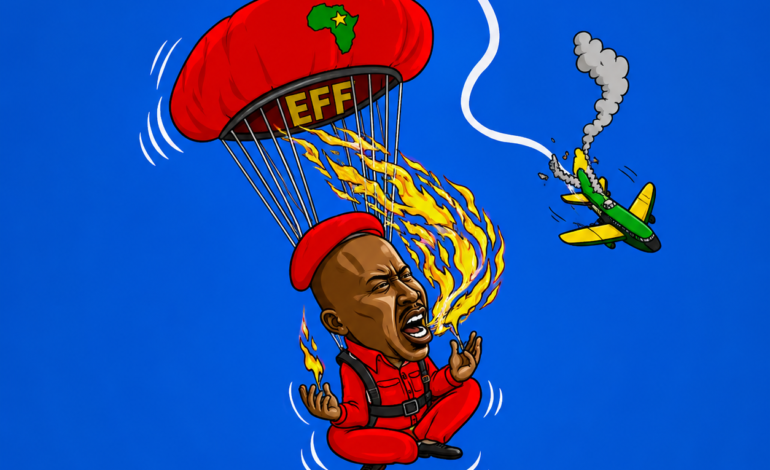
An unlikely hero has emerged from this sad episode in the person of Julius Malema, the activist turned parliamentarian. Malema has increasingly assumed the posture of a Pan-African nationalist, openly confronting the root causes of the crisis rather than merely exploiting popular anger for political gain. He has consistently argued that poverty, inequality, unemployment, and failed governance lie at the heart of xenophobic tensions in South Africa.
In doing so, he has attempted to provide a political and ideological roadmap rooted in African solidarity and social justice. His interventions have stood out as a worthy throwback to an earlier era of Pan-African consciousness when African leaders and movements understood that the destiny of the continent was interconnected. This contrasts sharply with the response of Godswill Akpabio, Nigeria’s Senate President, whose reaction has been widely interpreted as yet another opportunity for an expensive foreign junket funded with scarce public resources and hard currency. At a moment requiring serious reflection and statesmanship, Malema has projected clarity and conviction. Kudos to Julius Malema.