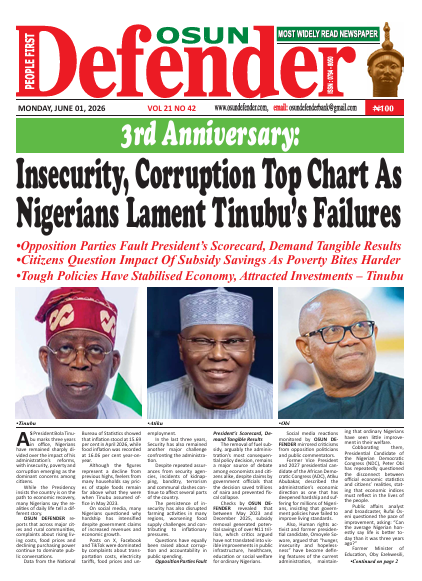


- Opposition Parties Fault President’s Scorecard, Demand Tangible Results
- Citizens Question Impact Of Subsidy Savings As Poverty Bites Harder
- Tough Policies Have Stabilised Economy, Attracted Investments – Tinubu
As President Bola Tinubu marks three years in office, Nigerians have remained sharply divided over the impact of his administration’s reforms, with insecurity, poverty and corruption emerging as the dominant concerns among citizens.
While the Presidency insists the country is on the path to economic recovery, many Nigerians say the realities of daily life tell a different story.
OSUN DEFENDER reports that across major cities and rural communities, complaints about rising living costs, food prices and declining purchasing power continue to dominate public conversations.
Data from the National Bureau of Statistics showed that inflation stood at 15.69 per cent in April 2026, while food inflation was recorded at 16.06 per cent year-on-year.
Although the figures represent a decline from previous highs, feelers from many households say prices of staple foods remain far above what they were when Tinubu assumed office in May 2023.
On social media, many Nigerians questioned why hardship has intensified despite government claims of increased revenues and economic growth.
Posts on X, Facebook and TikTok were dominated by complaints about transportation costs, electricity tariffs, food prices and unemployment.
In the last three years, Security has also remained another major challenge confronting the administration.
Despite repeated assurances from security agencies, incidents of kidnapping, banditry, terrorism and communal clashes continue to affect several parts of the country.
The persistence of insecurity has also disrupted farming activities in many regions, worsening food supply challenges and contributing to inflationary pressures.
Questions have equally been raised about corruption and accountability in public spending.
- Opposition Parties Fault President’s Scorecard, Demand Tangible Results
The removal of fuel subsidy, arguably the administration’s most consequential policy decision, remains a major source of debate among economists and citizens alike, despite claims by government officials that the decision saved trillions of naira and prevented fiscal collapse.
Checks by OSUN DEFENDER revealed that between May 2023 and December 2025, subsidy removal generated potential savings of over ₦11 trillion, which critics argued have not translated into visible improvements in public infrastructure, healthcare, education or social welfare for ordinary Nigerians.
Social media reactions monitored by OSUN DEFENDER mirrored criticisms from opposition politicians and public commentators.
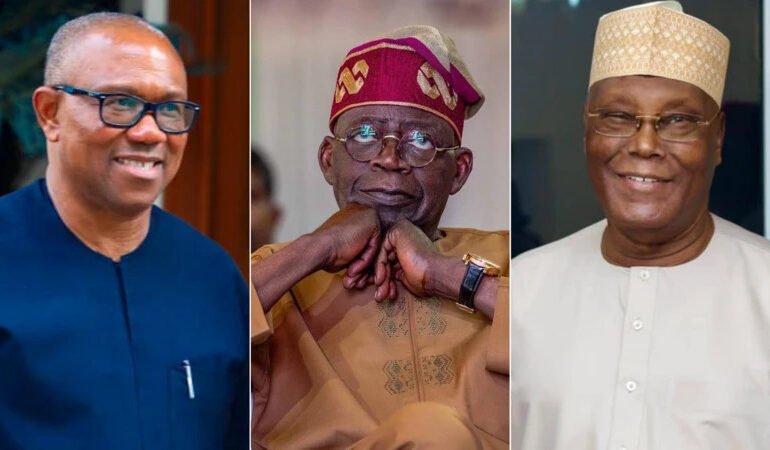
Former Vice President and 2027 presidential candidate of the African Democratic Congress (ADC), Atiku Abubakar, described the administration’s economic direction as one that has deepened hardship and suffering for millions of Nigerians, insisting that government policies have failed to improve living standards.
Also, Human rights activist and former presidential candidate, Omoyele Sowore, argued that “hunger, insecurity and hopelessness” have become defining features of the current administration, maintaining that ordinary Nigerians have seen little improvement in their welfare.
Corroborating them, Presidential Candidate of the Nigerian Democratic Congress (NDC), Peter Obi has repeatedly questioned the disconnect between official economic statistics and citizens’ realities, stating that economic indices must reflect in the lives of the people.
Public affairs analyst and broadcaster Rufai Oseni questioned the pace of improvement, asking: “Can the average Nigerian honestly say life is better today than it was three years ago?”
Former Minister of Education, Oby Ezekwesili, called for greater transparency in public spending, insisting that citizens deserve accountability for revenues generated from subsidy removal.
The Tanimu Turaki-led Peoples Democratic Party also said the administration’s anniversary celebrations were out of touch with the realities of Nigerians battling hunger and insecurity.
Similarly, The Labour Party argued that government claims of progress remain largely statistical, maintaining that citizens are more concerned about food prices, jobs and security than macroeconomic indicators.
- Tough Policies Have Stabilised Economy, Attracted Investments – Tinubu
The administration, however, rejects claims of failure.
In a statement marking the third anniversary, presidential spokesman Bayo Onanuga said Tinubu’s policies have stabilised the economy, improved government revenues and attracted fresh investments into key sectors.
According to the Presidency, exchange-rate reforms, subsidy removal and tax restructuring have strengthened fiscal sustainability and boosted investor confidence.
The government also pointed to improvements in oil production, growth in the non-oil sector, increased FAAC allocations and infrastructure projects across the country.
Supporters of the government insist that difficult reforms were necessary to avert economic collapse and create the foundation for long-term growth.
Yet for many Nigerians, the true measure of success remains whether those reforms will eventually translate into lower living costs, greater security and improved quality of life as Tinubu enters the twilight of his administration’s four years in office.