Adelabu’s Banding Failure: FG Moves To Solarise Public Institutions
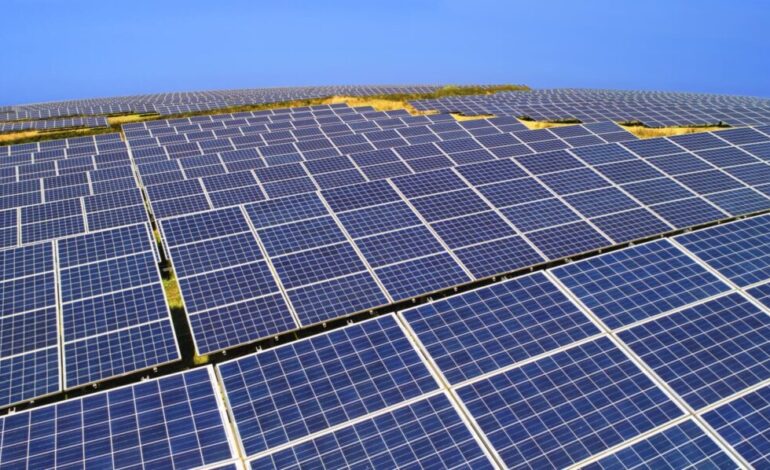


The Federal Government has unveiled a N100 billion solar power initiative aimed at supplying electricity to public institutions across the country, a move coming amid growing concerns over the effectiveness of the power sector’s banding policy introduced under the administration of the Minister of Power, Adebayo Adelabu.
The programme, known as the National Public Sector Solarization Initiative (NPSSI), is designed to reduce the dependence of government agencies on the unstable national grid by deploying renewable energy solutions.
Managing Director of the Rural Electrification Agency (REA), Abba Aliyu, disclosed the development on Monday while receiving the Administrator of the National Judicial Institute (NJI), Justice Babatunde Adejumo, during a visit to the agency’s headquarters in Abuja.
Aliyu said President Bola Ahmed Tinubu had approved the N100 billion intervention to support public institutions that continue to struggle with unreliable electricity supply and rising energy costs.
According to him, the initiative is part of the government’s broader plan to deepen electricity access through renewable energy while reducing the financial burden of conventional power supply on public institutions.
“President Bola Tinubu approved N100 billion for the National Public Sector Solarization Initiative, and this is an opportunity for institutions like the National Judicial Institute to benefit,” Aliyu said.
He explained that the project specifically targets public establishments that are either underserved by the grid or unable to sustain the rising cost of electricity under the current tariff structure.
Aliyu noted that the rollout of the programme has already begun in several strategic government institutions.
Among the beneficiaries are the Department of State Services (DSS), the Economic and Financial Crimes Commission (EFCC), the Independent Corrupt Practices and Other Related Offences Commission (ICPC), and the National Hospital in Abuja.
He added that several educational institutions across the country are also being integrated into the solarisation plan as part of efforts to strengthen public infrastructure through clean energy.
As part of the process, the REA boss said the agency would first conduct a comprehensive energy audit at the National Judicial Institute to determine the appropriate capacity of the solar mini-grid required for the facility.
“Once the energy audit is completed, we will determine the size of the mini-grid and the distribution network that will be deployed,” Aliyu explained.
In his remarks, Justice Adejumo emphasised the importance of stable electricity for the effective operation of judicial institutions.
He noted that modern judicial training, research activities, and digital legal processes require uninterrupted power supply, making alternative energy solutions increasingly necessary.
The solarisation initiative is expected to expand to more public institutions in the coming months as the Federal Government pushes renewable energy as a partial solution to Nigeria’s persistent electricity challenges.
OSUN DEFENDER reports that the development comes against the backdrop of persistent instability in Nigeria’s power sector, despite the introduction of the banding system which was meant to guarantee improved electricity supply based on service levels.
Under the policy, electricity consumers were categorised into service bands with promises of minimum daily supply hours. However, repeated grid collapses, fluctuating generation capacity and distribution challenges have left many Nigerians experiencing prolonged blackouts, even in areas supposedly placed under higher service bands.
For months, households and businesses across the country have complained that the banding framework has failed to translate into consistent electricity supply, raising concerns about the sustainability of the current power sector reforms. The situation has forced many institutions and private organisations to rely heavily on generators and alternative power sources.
Hafsoh Isiaq is a graduate of Linguistics. An avid writer committed to creative, high-quality research and news reportage. She has considerable experience in writing and reporting across a variety of platforms including print and online.
Related posts:
 Tariff Hike: Adelabu’s Banding System Is Discriminatory, It Shouldn’t Be Allowed, Ndume Blows Hot (Video)
 Keyamo: In Terms Of Managing Public Institutions, Atiku Was A Colossal Failure
 Engine Failure: National Assembly Moves To Investigate 2 Airlines Over Accident Of Emir Kano
 Insecurity: Kebbi Directs Closure Of All Public And Private Secondary Schools, Tertiary Institutions