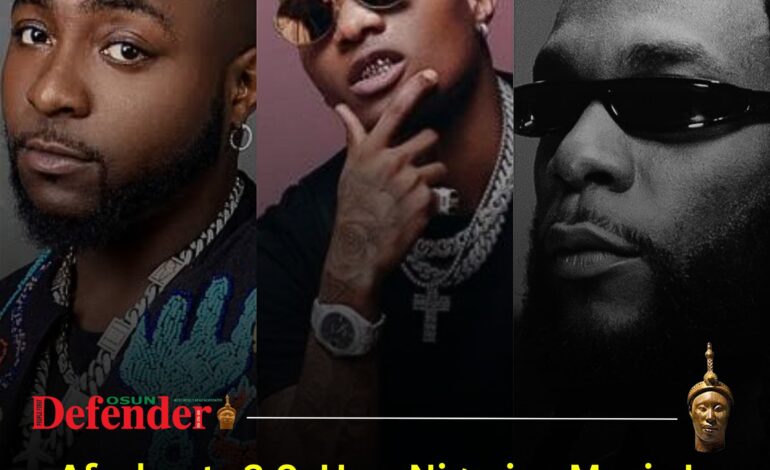
Afrobeats 2.0: How Nigerian Music Is Reinventing Itself In 2025


Nigerian music is experiencing a major transformation in 2025 as a new generation of artistes pushes the boundaries of Afrobeats, blending genres, innovating sounds, and exporting culture on a scale never seen before. Dubbed “Afrobeats 2.0,” this new wave is defined by experimentation, global collaborations, and deeper storytelling.
In the early 2010s, stars like Wizkid, Davido, and Burna Boy brought Afrobeats into global focus. Now, artistes such as Ayra Starr, Rema, Tems, Asake, and Odumodublvck are leading the next evolution — fusing traditional African rhythms with elements of R&B, trap, UK grime, amapiano, and soul.
One of the major shifts in 2025 is the fusion of highlife and indigenous languages with futuristic production. Artistes are going back to their roots while sounding ahead of their time. Asake, for instance, continues to dominate with his unique blend of Yoruba Fuji, gospel chant, and street-hop, layered over amapiano-style log drums. His sonic identity has inspired a crop of younger musicians to craft spiritual, chant-driven bangers.
Tems, known for her sultry, soul-infused vocals, has spearheaded what fans are calling “Afrosoul 2.0,” a deeply emotional and minimalist approach to music-making. Her songwriting continues to draw global acclaim, and her influence is evident in the increasing popularity of mellow, introspective tracks topping Nigerian and international charts.
Meanwhile, the rise of Nigerian hip-hop is being led by figures like Odumodublvck, who combines drill, Afrobeat, and street vernacular to create a genre-defying style he calls “Okporoko music.” His success has reignited interest in conscious rap, pushing lyrical storytelling back into mainstream conversations.
Streaming platforms have become key to this revolution. With Spotify, Apple Music, Audiomack, and Boomplay providing data insights, artistes now understand their audience better than ever. This has encouraged more strategic releases, genre experiments, and EP-length projects tailored for global discovery.
Collaboration is also redefining Afrobeats. Nigerian artistes in 2025 are partnering with a broader range of international acts — from Korean pop stars to Brazilian funk artistes. This globalisation is not diluting the music, but strengthening its reach and enriching its sound. Davido’s recent collaboration with Puerto Rican reggaeton star Rauw Alejandro and Ayra Starr’s duet with South Korean icon IU are examples of how Afrobeats is transcending linguistic and cultural barriers.
Another defining trait of Afrobeats 2.0 is the rise of independent artistes. With better access to music distribution, many rising stars are building audiences from their bedrooms, sidestepping traditional label deals. Social media platforms, especially TikTok, have become powerful discovery engines, launching careers and catapulting songs into viral success.
Behind the scenes, Nigerian producers like Sarz, P.Priime, London, and Magicsticks are driving the evolution with boundary-pushing beats. Their work is setting the pace globally, with international artistes increasingly tapping them for Afro-inspired records.
Thematically, Afrobeats in 2025 is moving beyond party anthems. Artistes are speaking more on identity, mental health, societal issues, and love with a rawness that resonates with global youth. This shift is cementing Nigerian music’s role not just as entertainment, but as cultural commentary.
Titilope Adako is a talented and intrepid journalist, dedicated to shedding light on the untold stories of Osun State and Nigeria. Through incisive reporting, she tackles a broad spectrum of topics, from politics and social justice to culture and entertainment, with a commitment to accuracy, empathy, and inspiring positive change.