Atiku Slams Tinubu’s ₦40.5trn Loan Bid, Says Nigeria’s Economy Now A Ponzi Scheme
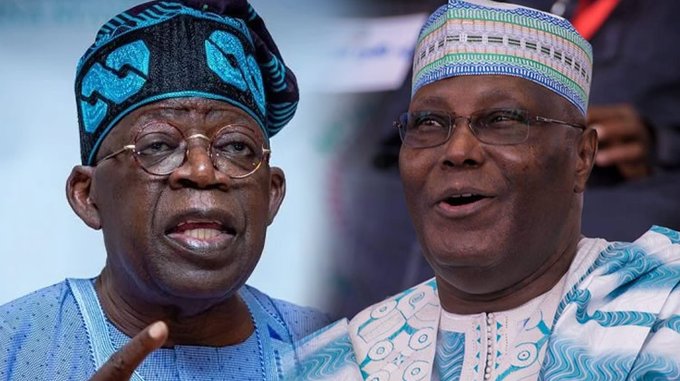

Former Vice President Atiku Abubakar has accused President Bola Tinubu of driving Nigeria into a financial crisis with reckless borrowing and excessive debt accumulation.
Reacting to Tinubu’s new ₦40.5 trillion loan request to the National Assembly, Atiku described the move as “a reckless and dangerous move that threatens the future of Nigeria and generations yet unborn.”
He warned that this latest borrowing would raise the country’s total debt from ₦97.3 trillion at the end of 2023 to ₦183.9 trillion — a staggering increase that, according to him, is both unsustainable and immoral.
“Since assuming office in 2023, President Bola Tinubu has been on a borrowing spree, with Nigeria’s public debt rising by ₦24.33 trillion in just six months — from ₦87.38 trillion in June 2023 to ₦97.3 trillion in December 2023,” Atiku said in a statement on Thursday.
“If the National Assembly approves this new request, Nigeria’s debt stock will rise from the current ₦97.3 trillion to ₦183.9 trillion. This means that in just two years, Tinubu would have added nearly ₦100 trillion to Nigeria’s debt stock.”
Atiku accused Tinubu of following the same dangerous borrowing pattern as his predecessor, Muhammadu Buhari.
“When Buhari took office in 2015, Nigeria’s total debt stock was ₦12.6 trillion. By the time he left in 2023, it had skyrocketed to ₦87.3 trillion. This represents an increase of ₦74.7 trillion, or a 594% rise.
“At this rate, Tinubu is set to break Buhari’s record and set a new and unfortunate one.
“Public debt in Nigeria has grown from ₦12.6 trillion in 2015 to ₦87.4 trillion in 2023, representing an increase of ₦74.8 trillion or a whopping 594%. If the new borrowing request sails through, the debt stock would have increased from ₦87.4 trillion to ₦183.9 trillion between 2023 and 2024. That’s an increase of ₦96.5 trillion in just two years — more than the entire debt accumulated by all past governments since 1999.”
“This is not just unsustainable — it is immoral.”
He accused Tinubu of using borrowed funds to service existing debts rather than investing in critical sectors.
“The Tinubu administration is borrowing money not for development, but to service existing debts — in other words, borrowing to pay interest on loans,” he said.
“This is economic sabotage. No nation can grow like this.”
He said the country’s debt-to-GDP ratio has become worrisome.
“Today, the debt-to-GDP ratio has crossed well beyond the 70% threshold if measured against actual revenues. That is a crisis. The administration’s claim that the debt-to-GDP ratio is within a manageable threshold is misleading because it is based on projected revenue, not actual revenue,” he said.
Atiku declared that Tinubu has turned Nigeria into a case study for bad economic policy.
“This addiction to borrowing, entrenched under the APC-led administration and now accelerated by President Tinubu, has turned public finance into a Ponzi scheme — borrowing to pay debt, then borrowing again to pay interest.
“Nigeria is now caught in a debt spiral, a vicious cycle that mortgages the future to pay for the past.”
He called on the National Assembly, civil society, the media, and the international community to intervene.
“The National Assembly, civil society organisations, the media, and the international community must now act. We cannot continue to fold our arms while the country is being sold into debt slavery.”
Meanwhile, President Tinubu defended his administration’s handling of the economy during his national broadcast marking Democracy Day on Wednesday.
He said, “Our debt position is improving. While foreign exchange revaluation pushed our debt-to-GDP ratio to around 53%, our debt service-to-revenue ratio has declined from 111.8% in 2022 to 66.9% in 2023, and 45% in the first quarter of 2024.
“This clearly shows that we are meeting our revenue targets and our obligations.”
Tinubu had also highlighted the growth in external reserves.
“In addition, we have paid down ways and means in 2023 by ₦4 trillion. External reserves have grown from $33 billion in June 2023 to $38 billion in May 2024 — a growth of $5 billion.”
Titilope Adako is a talented and intrepid journalist, dedicated to shedding light on the untold stories of Osun State and Nigeria. Through incisive reporting, she tackles a broad spectrum of topics, from politics and social justice to culture and entertainment, with a commitment to accuracy, empathy, and inspiring positive change.