The 2026 Osun State governorship poll is about six months away, and while it may appear like just another election for political gladiators eager to taste power, it means something deeper for citizens yearning for a new dispensation.
More importantly, political activities have already kicked off as parties and their supporters prepare for the polls.
The Independent National Electoral Commission (INEC) has fixed the election for August 8, 2026. The date does not appear to be a coincidence, as it falls on a day after the finale of the annual Osun-Osogbo Festival.
The Osun-Osogbo Festival is an annual Yoruba cultural and spiritual celebration held between July and August. The festival honours Osun, the goddess of fertility, love, and water and is centred around the sacred Osun Grove in Osogbo – a UNESCO World Heritage Site that attracts thousands of worshippers and visitors from all walks of life every year.
Celebrations usually run for about two weeks, with different activities lined up for each day. These include the Iwo-popo (ritual street cleansing), Atupa-Oloju-Merindinlogun – the lighting of the traditional sixteen-point lamp, among others, leading up to the grand finale, which is the most symbolic part of the festival.
The grand finale features the Arugba procession, during which a young virgin from a royal family carries a sacred calabash filled with offerings from the palace to the Osun Grove. This solemn ritual represents purity, devotion, and the continuity of tradition.
At the centre of this year’s celebration is the Osun governorship election, where citizens will decide who occupies the Bola Ige House for the next four years.
Aregbesola and Religious Inclusiveness (The Birth of Isese Day)
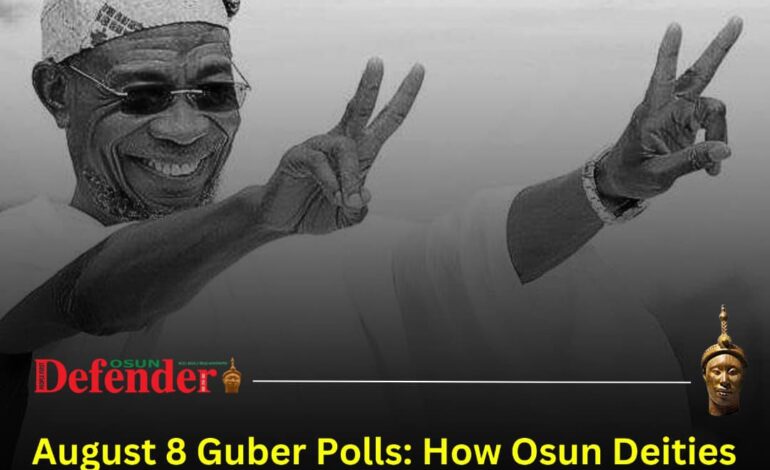
Down memory lane, it remains etched in history that the immediate past Minister of Interior, Ogbeni Rauf Aregbesola, during his tenure as Osun State Governor, gave recognition to traditional religion, which had long been relegated to the background.
“Ogbeni,” as he is fondly called, gave a distinct identity to traditional worshippers as adherents of a legitimate faith, rather than being labelled as “ritualists,” as they were often perceived by followers of other religions.
To give them a sense of belonging and reinforce the belief that a governor governs everyone regardless of religious affiliation, Aregbesola approved a public holiday known as Isese Day.
In a statement, he was quoted as saying: “Pursuant to Section 2 (2) of the Public Holidays Act CAP P40 Laws of the Federal Republic of Nigeria 2010, the 20th day of August is hereby scheduled as a special public holiday for the celebration of Isese Day for all adherents of Traditional African Religion.”
Like other public holidays, civil servants in Osun State were directed to stay at home to observe the day.
That singular declaration has since grown into a full-blown celebration across several South-West states. OSUN DEFENDER reports that governments across the region declared a work-free day for public servants to commemorate the 2025 Isese Festival. A day set aside to celebrate Yoruba culture, spirituality and indigenous traditions.
Today, Isese Day, now officially recognised in many South-West states, has become a symbol of Yoruba cultural pride and religious inclusivity, with increasing calls for its nationwide adoption.
This recognition emboldened traditional worshippers to openly practise their faith and organise themselves under the Traditional Religious Worshippers Association (TRWASO). Through the association, they have continued to press demands on the government to revive and preserve Yoruba culture and traditions that were once at risk of extinction.
How the Odds May Be in Aregbesola’s Favour
What makes the timing of the election particularly striking is that many adherents and devotees of Osun will already be in Osogbo for the Osun-Osogbo Festival.
While political camps are calculating strategies on how to secure entry into the Bola Ige House, Aregbesola’s camp —the African Democratic Congress (ADC) — may be benefiting from forces beyond conventional politics.
Among traditional worshippers, there is a strong belief that deities do not forget those who honour them. To many devotees of Osun, Aregbesola’s actions while in office were not mere political decisions but acts of recognition and respect for ancestral faith and culture.
With prayers, sacrifices, and rituals ongoing during the festival period, some worshippers believe the deities may use the election as a moment of recompense — rewarding the man they see as having restored dignity to traditional religion.
If human beings have refused to fully acknowledge Aregbesola’s role in giving identity and voice to traditional worshippers, believers say the spiritual forces and terrestrial beings may choose the ballot as their own means of expression.
In their view, favour may tilt towards the ADC, not through noise or aggression, but through alignment of time, memory, and spiritual gratitude. As voters cast their ballots on August 8, some believe unseen hands may also be at work, guiding the outcome in favour of those who once stood for them.
Whether seen as a coincidence or divine orchestration, the convergence of Osun’s sacred season and Osun’s political future has added a spiritual layer to the 2026 governorship contest, one that may yet shape the final result at the polls.

Hafsoh Isiaq is a graduate of Linguistics. An avid writer committed to creative, high-quality research and news reportage. She has considerable experience in writing and reporting across a variety of platforms including print and online.