Beyond Convoys: The True Measure of Good Governance in Osun


- By Wahab Abiona
As Osun State moves steadily toward the August 15, 2026 governorship election, the quality of public discourse surrounding leadership deserves urgent elevation beyond superficial judgments and political theatrics. Governance, by every credible democratic standard, is neither measured by the length of a convoy nor by the intimidating presence of armed escorts. It is measured by the clarity of vision, the strength of policy direction, and, most importantly, the tangible improvement in the lives of citizens.
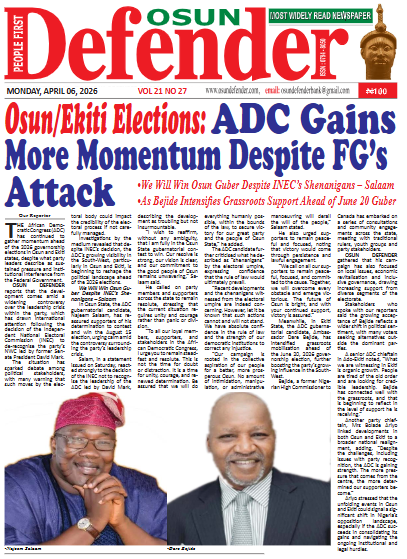
This distinction becomes particularly relevant in the face of recent criticisms directed at Dr. Najeem Folasayo Salaam, candidate of the relevant political party, whose detractors appear determined to reduce leadership capacity to displays of material power.
Such arguments betray a troubling misunderstanding of democratic governance. Leadership is not an exhibition of privilege; it is an exercise in responsibility, competence, and measurable service delivery.
Across the local governments of Osun, Dr. Salaam has adopted a notably grassroots approach, engaging communities directly and articulating policy alternatives rooted in local realities. Rather than resorting to spectacle, he has consistently projected a development-focused agenda built around practical programmes and institutional reform.
In established democracies such as the United States and United Kingdom, leadership legitimacy is earned through policy effectiveness, transparency, and accountability not through ostentatious displays of wealth or exaggerated symbols of power.
At the heart of good governance lies vision. A serious leader must possess a coherent roadmap for economic growth, infrastructure renewal, educational advancement, and healthcare delivery. On this score, Salaam’s public engagements suggest a candidate who understands the urgency of development planning and the need for realistic policy execution.
Integrity remains another indispensable pillar. Public office demands moral discipline because leadership without ethical restraint often results in weakened institutions and deepened public distrust. A society that has repeatedly witnessed the corrosive effects of self-serving governance cannot afford to trivialize character in leadership selection. Salaam’s professional disposition and public record project an image of accountability that voters may find increasingly relevant in the present political climate.
Competence, too, cannot be discounted. Modern governance requires intellectual depth, analytical ability, and an appreciation of the increasingly complex demands placed on subnational administrations. Academic preparation and policy literacy are no longer optional assets; they are essential requirements for leaders expected to navigate fiscal pressures, employment challenges, and social welfare demands in a changing economy.
Closely linked to competence is exposure. Leadership benefits from an understanding of both local circumstances and wider policy experiences beyond immediate political environments. Exposure broadens perspective and enables adaptation of tested solutions to local realities. For a state such as Osun, where developmental choices must increasingly reflect innovation and sustainability, such attributes deserve attention.
Most importantly, governance must remain people-centred. Policies that create jobs, empower young people, strengthen small businesses, and expand social protection frameworks offer more lasting value than short-lived populist gestures. Sustainable development requires institutions, not tokenism; systems, not slogans.
The political history of Osun, like that of many states, offers sufficient evidence that personal wealth is no substitute for effective governance. Financial status neither guarantees competence nor assures public commitment. What ultimately matters is performance, institutional impact, and the ability to improve collective welfare.
As voters prepare for another defining electoral decision, the burden is to assess candidates beyond appearances and political noise. The future of Osun will not be secured by convoys, but by ideas; not by spectacle, but by substance. In that conversation, Dr. Najeem Folasayo Salaam presents himself as a candidate whose appeal rests less on display and more on developmental intent.
The opinions expressed in this publication are solely those of the author. It does not represent the editorial position or opinion of OSUN DEFENDER.
Related posts:
 Update: Osun Decides: Army GOC, Police DIG Under Pressure To Compromise Security Measure
 High School Mass Shootings: Trump Embraces Tougher Gun Control Measure
 Kidnapping: Kebbi Govt Announces Closure Of 7 Schools Over Safety Measure
 Alleged Airport Extortion: NSCDC CG Orders Full Disciplinary Measure