Controversy, Knocks As Tinubu Promotes ADC, Nurudeen Yusuf, Twice In One Year
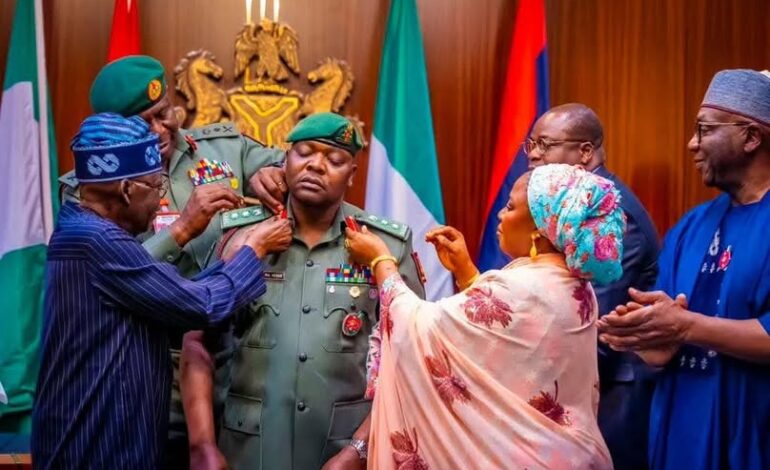


Controversy has surrounded the promotion of President Bola Tinubu’s Aide-de-Camp (ADC), Nurudeen Yusuf, to the rank of Brigadier-General.
The promotion, it was gathered, has sparked murmuring and discontent within the Nigerian Army.
In a letter dated 12 December 2025 and addressed to the Chief of Army Staff, Lt.-Gen. Wahid Shaibu, the National Security Adviser, Nuhu Ribadu, conveyed the President’s approval for Yusuf’s elevation.
However, the decision has raised eyebrows among Nigerians.
Reacting to the news, Muhammad Bello Buhari slammed President Tinubu for the decision, noting that the Nigerian Armed Forces ‘ elevation from Colonel to Brigadier-General requires 5 years at the rank of Colonel and attendance at the War College, the National Defence College or its equivalent.
According to him, Col. Yusuf has attended neither.
He said, “As a 52 Regular Course officer, this promotion places him senior to officers of the 50 Regular Course who have completed both colleges and are legitimately awaiting promotion.
“From 1960 to date, no President’s ADC has enjoyed such an exception.
“The late President Buhari’s first ADC, then Col. M.L. Abubakar (now Brig-Gen), had to disengage from his ADC appointment to attend the National Defence College before he could be considered for promotion. He remained a Colonel for five years, in line with the Armed Forces Terms and Conditions of Service.
“Today, however, we have an officer who spent barely a year as a Colonel, has not met the professional requirements, yet has been elevated to Brigadier-General—and still retained to continue performing ADC duties [as a General] an arrangement that is absolutely alien to military tradition.”
Buhari alleged that Col. Yusuf’s case was not the only aberration going on in the presidency.
According to him, “The Chief Personal Security Officer to the President, CP Usman Shugaba, has reportedly received three accelerated promotions in the Police, leapfrogging peers who remain CSPs, SPs, and DSPs purely based on proximity to power.
“Such practices may be familiar within the Police system, but they are alien to the military, where structure, seniority, and professionalism are sacrosanct.
“It is therefore not surprising that the conveying letter reportedly came from the office of the NSA—a retired police officer—effectively importing police disorder into the military institution.”
He accused Tinubu of governing by favouritism and running an administration that steadily converts proximity to power into a substitute for merit.
“But the blame does not rest there. The ultimate responsibility lies with the President, who sets the tone, authorises the exceptions, and normalises the erosion of standards.
“This is not about Col. Yusuf. This is not even about the Police or the Military. This is about a President who appears increasingly comfortable governing by favouritism, and an administration steadily converting proximity to power into a substitute for merit.
“But the real concern is not the individuals. It’s the message being sent to the rank and file. It is the silent demoralisation of officers who played by the rules. It is the corrosion of trust within the ranks. It is the message that professionalism is optional if one is close enough to the throne.
“When privilege overtakes process, when proximity replaces professionalism, and when rules bend for a few, the institution itself begins to rot.
A system that rewards access over merit cannot command discipline, loyalty, or trust. This is how institutions collapse— quietly, incrementally, and from the top. And this is just one case among many,” Buhari added.
Olamilekan Adigun is a graduate of Mass Communication with years of experience in journalism embedded in uncovering human interest stories. He also prioritises accuracy and factual reportage of issues.