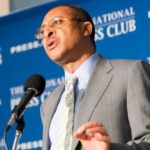
Court Warns DSS, Pat Utomi Against Undermining ‘Shadow Government’ Suit



The Federal High Court in Abuja has warned the Department of State Services (DSS) and Professor Pat Utomi not to take any action that could render an ongoing lawsuit ineffective.
Justice James Omotosho issued the caution on Wednesday after counsel for the DSS, Akinlolu Kehinde (SAN), alleged that Utomi was making moves related to the case despite it being sub judice.
The DSS filed suit number FHC/ABJ/CS/937/2025 against the political economist, accusing him of attempting to launch a “shadow government” in Nigeria.
The agency argued that such a move would contravene the Constitution and pose a threat to national stability.
The DSS also sought an interlocutory injunction to stop Utomi and his associates from organising rallies, protests, or granting media interviews related to the matter.
According to the DSS, intelligence reports indicated that Utomi had finalised plans for public campaigns and road shows to promote the alleged initiative.
When the case was called, Utomi, who was present in court, was represented by Chief Mike Ozekhome (SAN).
Mr. Adedayo Adedeji (SAN), appearing on behalf of Mr. Joseph Daudu (SAN), also entered an appearance as amicus curiae.
An amicus curiae, or “friend of the court,” is someone not directly involved in the case who provides expert input to assist the court in making a sound decision.
Justice Omotosho said that after reviewing both the DSS’s originating process and Utomi’s counter-affidavit, he had invited at least six distinguished legal minds—one from each of Nigeria’s six geopolitical zones—to advise the court due to the national importance of the matter.
He stated that the selection was gender-balanced.
“I have invited amicus curiae from each political zone to represent each zone because this issue has national interest, that is, national outlook as regarding the nature of the suit,” he said.
“I deemed it fit to invite vice chancellor of university, Senior Advocates of Nigeria (SAN), and professors of law of repute,” he added.
He said the input from the invited amici curiae would be shared with all parties before final hearing and judgment.
Among those invited are Prof. Ademola Popoola, Professor of International Law and Jurisprudence at Obafemi Awolowo University (OAU), Ile-Ife; Prof. Uchefula Chukwumaeze, Vice Chancellor of Imo State University; and Mr. Joseph Daudu (SAN).
Others include Mr. Joe Gadzama (SAN); Prof. Dakas Dakas (SAN), former Dean, Faculty of Law, University of Jos; Mrs. Miannaya Essien (SAN); and Yakubu Maikyau (SAN), former President of the Nigerian Bar Association (NBA).
DSS counsel Kehinde told the court that a motion for interlocutory injunction had been filed on June 4 to restrain Utomi from holding any rallies.
“I will like to get my lord’s directive in the motion of notice for interlocutory injunction that is ripe for hearing this morning,” Kehinde said.
In response, Ozekhome thanked the court for inviting amici curiae from all six geopolitical zones and noted the gender balance.
However, he objected to hearing the interlocutory motion.
“We have to first know the face of this case before the interlocutory injunction which we have kicked against because it is asking for a relief in the main suit,” he said.
Justice Omotosho ruled that the court would not entertain the interlocutory application to avoid delays, opting instead for accelerated hearing of the main case.
He stated that the preliminary objection and originating summons would be heard together, with judgment starting from the objection before addressing the substantive suit.
Kehinde, however, insisted that the motion was necessary to prevent Utomi from taking steps that could prejudice the case.
“My lord, I will ask for status quo to be maintained because certain steps are being taken by the defendant,” he added.
Justice Omotosho then cautioned all parties against making the case ineffective through their actions.
“I think it is trite law that when a process is served on the other party, you do not take action that will make the suit to be nugatory,” he said.
“I think the defence counsel too knows this and any action taken will have consequences.”
“I have made my intention known. No party should take any step that will make the suit nugatory. Any action taken will be nullified by this court.”
“Upon receipt of the positions of amici curiae, we will serve you (the parties). Let us not take steps that will make the outcome nugatory,” he warned.
The case was adjourned to July 10 for hearing.
In a preliminary objection filed by Ozekhome, Utomi urged the court to dismiss the suit for lack of jurisdiction.
He argued that the case lacked a valid cause of action under the National Security Agencies Act, Cap N74, Laws of the Federation of Nigeria, 2004.
He maintained that issues like civic engagement, formation of shadow cabinets, and public policy debates fall outside the DSS’s statutory functions under Section 2(3) of the Act.
He stated, “The reliefs sought by the plaintiff/respondent seek to criminalise constitutionally protected rights to freedom of expression, association, and political participation contrary to Sections 39 and 40 of the 1999 Constitution (as amended).”
“The suit amounts to an abuse of court process, is speculative, incompetent, inchoate and lacks any legal foundation.”
Utomi asked the court to strike out or dismiss the suit on those grounds.
In a supporting affidavit which he personally deposed to, he described the suit as speculative, hypothetical, and premature, relying solely on suspicion without factual backing.
He also argued that the DSS lacked locus standi (legal standing) to institute the action in the way it did.
Titilope Adako is a talented and intrepid journalist, dedicated to shedding light on the untold stories of Osun State and Nigeria. Through incisive reporting, she tackles a broad spectrum of topics, from politics and social justice to culture and entertainment, with a commitment to accuracy, empathy, and inspiring positive change.