Editorial: Bayo Onanuga In Wonderland
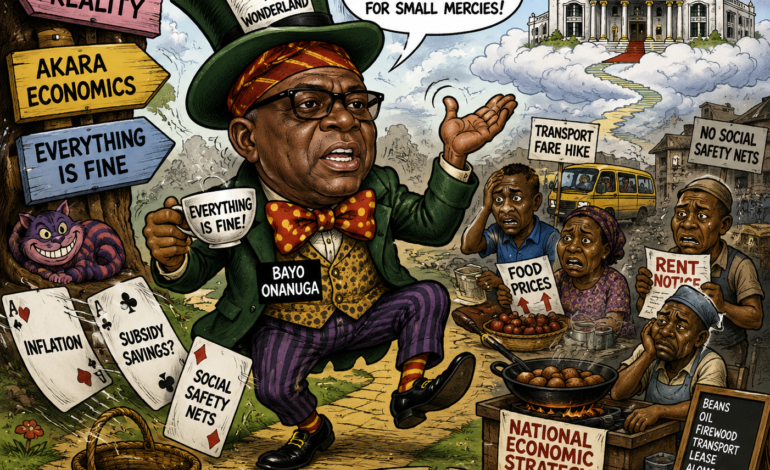


We are living in an age where alternative realities are increasingly being constructed through the denial of life’s often grim truths. What was once dismissed as a world of make-believe is now described as an “alternative reality”. In its most extreme form, it becomes an exercise in magical realism.
In attempting to paint a rosy picture of Nigeria’s economic situation, a key presidential spokesman recently wandered into the theatre of the absurd. If he is to be believed, Nigerians are enjoying better living standards, greater prosperity and should be grateful for the “small mercies” brought about by the government’s policies.
The seasoned broadcaster interviewing him skilfully concealed his disbelief, even as the conversation drifted into Alice in Wonderland territory. But Alice in Wonderland is a work of children’s fiction. Nigerians, by contrast, are grappling with the harsh realities of declining living standards, shrinking purchasing power and an ever-deepening cost-of-living crisis.
Ordinary Nigerians do not live in the comfort and opulence of the Presidential Villa. They do not enjoy official security details, subsidised living or the many privileges of public office. Instead, they contend daily with demanding landlords, soaring transport fares, rising food prices and countless unexpected financial shocks. Worse still, the state has failed to establish the social safety nets that should cushion citizens from these economic hardships.
While presenting his optimistic narrative, the presidential spokesman was unable to explain how the savings from fuel subsidy removal have been channelled into building the robust social protection systems repeatedly promised by the government. Such an explanation would inevitably require identifying the actual beneficiaries of these programmes.
The week also introduced another troubling dimension to the government’s economic narrative: what has now been dubbed “Akara Economics”. This philosophy appears to promote subsistence entrepreneurship as a pathway to prosperity. Yet no serious economy can be built on the expectation that citizens will escape poverty simply by frying and selling akara. Once the costs of ingredients, transportation, energy and the numerous informal levies imposed by non-state actors are taken into account, the mathematics simply does not add up.
A more sustainable approach would be to revive and strengthen cooperative societies, as was successfully practised in the old Western Region. Cooperatives also underpin the remarkable agricultural success of the Netherlands, one of the world’s largest food exporters despite possessing only a fraction of Nigeria’s landmass.
Cooperatives mobilise capital, promote shared ownership, build skills and create sustainable wealth. Poverty is not defeated by encouraging roadside survival businesses. Rather, cooperatives can establish modern food-processing enterprises capable of producing akara flour, packaged bean products or commercialising local delicacies such as Dodo Ikire. That represents enterprise. Encouraging individuals to remain trapped in low-income informal activities does not.
Few Nigerians are persuaded by this excursion into a world of make-believe. The Federal Government must urgently re-evaluate its economic policies and place the welfare of ordinary citizens at the centre of governance. Economic policy should prioritise productive investment, social protection and broad-based prosperity—not speculation, survival economics or policies that leave the majority struggling while a privileged few prosper.
Economic reforms cannot be judged solely by macroeconomic indicators or the applause of international financial institutions. Their true measure lies in the quality of life experienced by ordinary citizens. When inflation consistently outpaces wage growth, when families skip meals to survive, and when businesses close under the weight of rising operating costs, official assurances that “things are getting better” ring hollow. Economic policy succeeds only when its benefits are felt at the grassroots.
There is also an urgent need for government communication to be rooted in empathy rather than public relations. Citizens are more likely to support difficult reforms when they believe their leaders understand the sacrifices being demanded of them and are making genuine efforts to ease the burden. Attempts to minimise hardship or portray widespread suffering as evidence of resilience only deepen public distrust and widen the gap between government and the governed.
Nigeria possesses the human and natural resources to build a resilient and prosperous economy. What is required is leadership that confronts reality with honesty, designs policies around productive sectors of the economy, and protects the most vulnerable through effective social interventions. A government that listens to its people, acknowledges their struggles and adjusts its policies accordingly will earn far greater credibility than one that insists all is well while millions continue to grapple with economic hardship.