
The governorship election in Osun State in 2018 was clearly going to be contentious even before its inception. There had hitherto been in place an existing unwritten, informal agreement about a succession program, which, given the nature of Nigeria’s evolving democracy, was tailored to the fact that the Western Senatorial District should succeed the outgoing governor, who came from the Eastern Senatorial District.
This is not an ideal proposition, but democracies across the span of political history have evolved to suit local cultures, norms, and traditions. As the management guru Peter Drucker is often quoted as saying, ‘Culture will eat strategy for breakfast.’ This is the nature of democracy. In countries described as “Advanced Democracies,” much of the practice of democracy evolved around unwritten “National (or local) democratic agreements”.
Despite what can only be interpreted as pressures from above, and in the spirit of party cohesion and the Democratic Centralism, upon which modern political parties are based, the outgoing governor of Osun State at the time had to support a candidature from the Central Senatorial District. It is admirable that, despite reservations across the board within and outside the party, and within conventional wisdom, he did so unflinchingly, with stoic resolve.”
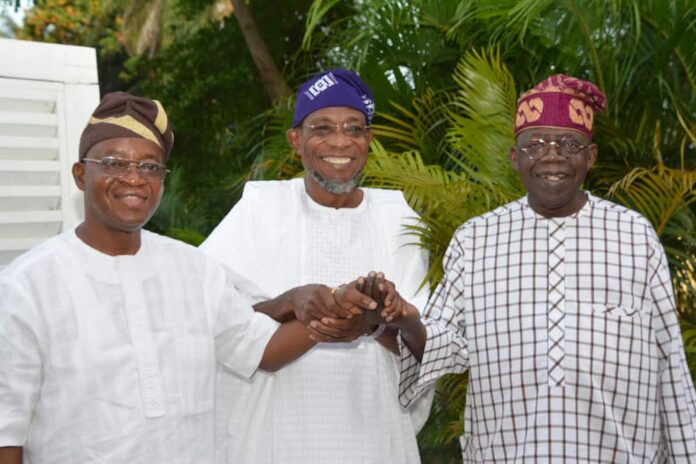
Aregbesola, as the outgoing governor, is to be commended for insisting that the candidature could be made more flexible, i.e., that it wouldn’t undermine the unwritten agreement if it were ceded in another senatorial district. If we examine the contemporary political history of Osun State, outgoing Governor Rauf Aregbesola used his political capital to support the candidature of Gboyega Oyetola, which almost backfired.
Credit must be given to Aregbesola for using great desterity and tactical acumen to ensure damage control. With the benefit of hindsight, it was clearly a risky move to disregard the unwritten agreement about rotation, which would have ceded the candidacy of any of the major parties to the Western Senatorial District. Doing so came with a heavy price, as the margin of victory was narrow, and a lot of Aregbesola ‘s own political capital was undermined and diminished.
The imposition cost the party dearly, nearly splitting it into two, with defections to the ADP and PDP. They almost lost the election, only managing to snatch victory from the jaws of defeat.”
“Aregbesola’s tactical maneuver in the face of daunting odds was indeed ingenious. It confirms the dilemma of the political player at a critical juncture, echoing the sage like observation that ‘men make their own history, but they do not do so of their own free will; they do so in circumstances and situations which they would neither have wanted nor desired, and have only a limited amount of time upon which to impart their own agency.’
“Had Aregbesola stuck to the principle position that the candidature of any major political party should be ceded to the Western Senatorial District for fairness and equity. The end result would have been catastrophic – the APC would have been split into several warring factions, threatening the stabilization of polity in the state, and potentially spilling over into violence. That he avoided this outcome should give him great kudos. He sacrificed his own political capital to accept orders from above, ensuring party cohesion and preventing the party from squandering too much goodwill and capital.
The price he paid was that the outstanding programs he initiated and pursued, which were groundbreaking and game-changing, were not built upon or sustained. Unfortunately, the schism had more to do with deeper issues than temporary political inconveniences. There was a lack of ideological cohesion within the APC, and unfortunately, a lot of personal disenchantment against a man perceived to be charismatic and having a common touch. The price for this is painful, as a program that should have been continuously built upon was jettisoned.
This has to be reversed. What happened in the past shows that political parties in Nigeria must find a way to be more cohesive ideologically and to observe unwritten agreements for fairness and equity.
Related posts:
 Breaking: ISWAP Carried Out Owo Catholic Church Attack – Aregbesola
 Osun 2018: APC, PDP, SDP In Succession Battle
 Recession: Aregbesola Solicits Support for Government, Says Good Governance Lies in the Hands of All
 Stop Telling Lies Against Aregbesola, Our Salaries Paid Up To June – Osun NLC Chair, Adekomi