Ekiti ADC Secretariat Attack: Who’s Afraid of ADC?
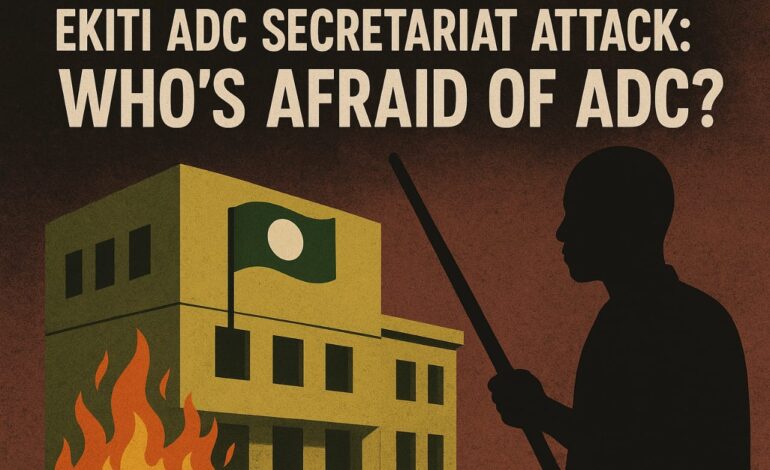


The late-night inferno that engulfed the African Democratic Congress (ADC) secretariat in Ado-Ekiti may have reduced the building to ashes, but it has ignited a fiery debate about Nigeria’s shrinking democratic space and the rising intolerance for opposition voices.
When residents of Ado-Ekiti woke up on Tuesday morning to see the once-bustling ADC office in ruins – charred banners, burnt campaign materials, and debris scattered across the premises – disbelief quickly turned to outrage.
A viral video shared on the party’s official Facebook page captured the secretariat completely consumed by flames. Party members alleged that the arson was politically motivated and carried out by suspected thugs linked to the ruling All Progressives Congress (APC).
The attack occurred just hours before the ADC’s planned Reconfiguration and Affirmation Ceremony for its new executive committees, fuelling suspicion that the arson was intended to disrupt the party’s internal consolidation.
Condemnations poured in swiftly from political observers and Nigerians watching the events unfold, many of whom decried what they called “a creeping return to authoritarianism.”
Previous Attacks on ADC
The Ekiti arson is the latest in a disturbing pattern of coordinated aggression against ADC members across the country. Several violent incidents have been recorded since July, when the Opposition Coalition publicly endorsed the ADC as its preferred platform ahead of 2027.
In Kaduna, on August 30, ADC leaders were attacked when an inauguration event was violently disrupted. In September, in Lagos, the campaign office of former Minister of Interior, Rauf Aregbesola, was reportedly vandalized by suspected political thugs amid rising intra-party tensions within the APC.
In early September, the convoy of former Attorney-General of the Federation, Abubakar Malami, was also attacked by unknown assailants in Birnin Kebbi. Similarly, the ADC secretariat in Dekina, Kogi State, was targeted by suspected political thugs, leaving several members injured.
These recurring attacks, according to analysts, reveal a troubling trend one where political competition is increasingly replaced by intimidation and violence.
APC Waging Quiet War Against Us — ADC, Aregbesola React
Reacting to the incident, the ADC National Publicity Secretary, Mallam Bolaji Abdullahi, described the Ekiti attack as “a deliberate act of political terrorism aimed at silencing opposition voices.”
“Since the Opposition Coalition unveiled ADC as its party of choice in July, our members and structures have faced serial attacks across Nigeria. The APC can feel the ground shifting beneath them, and the fire in Ekiti is further confirmation that they are afraid of the rising wave of the ADC,” Abdullahi said.
He called on the Independent National Electoral Commission (INEC) and civil society organisations to intervene and demand accountability from security agencies. “What is especially troubling,” he warned, “is the silence that follows these acts. A system that looks away while opposition parties are violently suppressed is a system begging for crisis.”
Lending his voice to condemn the attack, former Minister of Interior and ADC National Secretary, Ogbeni Rauf Aregbesola, described the situation as “a shameful display of intolerance and a dangerous signal for democracy.” He noted that those who came to power through democratic means now resort to intimidation and violence to stay there. “The attack on ADC members in Ekiti signals a descent into fascism,” Aregbesola declared.
Similarly, the Ayodele David-Adesua Campaign Organisation (ADACO) described the burning as “a barbaric and cowardly assault on democracy,” alleging that it was part of a coordinated effort to destabilize the ADC ahead of the 2027 general elections.
ADACO maintained that the ADC would not be cowed: “Despite the ashes, our Affirmation Ceremony in Ekiti will proceed — whether in a hall or under a tree. Those who resort to fire do so only when they have run out of arguments,” the campaign organisation said defiantly.
Is APC Afraid of an Opposition Merger?
Despite repeated calls for tolerance, political violence continues to fester across Nigeria. Observers said the incident is part of a larger wave of politically motivated violence sweeping across the South-West and other regions where the ADC is gaining ground. They argue that there is no reasonable explanation for these unprovoked attacks on a party simply building its structure and expanding its base.
Speaking on the attack, a political analyst Dr. Ayokunle Omisina believed the attack was orchestrated by those intimidated by the ADC’s rapid growth and rising national appeal. “Those who see the ADC’s energy and organisation know it threatens their political future,” he said. “What we are witnessing is fear disguised as aggression.”
Inside sources within the ADC told Osun Defender that the Ekiti attack may have been triggered by the party’s growing popularity and internal reorganization plans that unsettled the local political order.
Another observer, Kayode Adeagbo, said the arson was a deliberate attempt by the ruling APC to frustrate opposition growth; a claim that seems consistent with former Lagos governor Babatunde Fashola’s recent comments that an opposition merger is “impossible.”
Fashola’s Take
Former Lagos State governor, Babatunde Fashola, recently declared that it would be impossible for the opposition to form a successful merger ahead of the 2027 elections. “Only the APC has conducted a merger that worked. Others can’t,” Fashola boasted during an APC stakeholders’ meeting in Lagos.
The statement, which many interpreted as arrogance, has sparked outrage among opposition figures, who view it as a veiled admission that the ruling party seeks to dominate Nigeria’s entire political landscape.
Speaking differently, political commentator Mr. Dotun Arigbabuwo said he does not believe the ruling party should be afraid of any opposition merger given the recent defection spree that has seen sitting governors including Bayelsa’s Douye Diri and Enugu’s Peter Mbah cross over to the APC. He described the defection wave as part of a grand strategy to consolidate power ahead of 2027.
Despite having control of most states and political structures nationwide, critics wonder why the APC still feels threatened by a rising opposition party like the ADC.
“If they have governors in almost all 36 states and control the political machinery, why fear a party still building its base?” one analyst asked. “The jittery response to ADC’s growth shows insecurity at the heart of the ruling establishment.”
Analysts Sound Alarm on Democracy
Political analysts view the arson attack in Ekiti and the broader harassment of opposition groups as more than isolated violence. They see it as part of a calculated effort by the ruling party to clip the wings of the opposition and turn Nigeria into a de facto one-party state.
They argue that while the ruling party is swift and ruthless in monitoring, intimidating, or suppressing opposition, its responsiveness to national crises including economic hardship, insecurity, and education collapse remains painfully slow.
In his own view, Kareem Dusumu draw parallels between the government’s zeal in pursuing opposition voices and its lethargy in addressing economic and social crises.
“If the same zeal applied to crushing rivals were applied to fixing electricity, education, healthcare, and others Nigeria wouldn’t be in this mess,” remarked Dosumu.
He continued, “The ruling party claims not to fear competition,” another added, “yet its actions suggest deep insecurity. If confident in its performance, there would be no need to burn offices, intimidate rivals, or orchestrate defections.”
“Rather than preoccupy itself with arson and propaganda, the APC should focus on jobs, security, and governance. A government that fears competition is already on the defensive,” Dosumu said.
Hafsoh Isiaq is a graduate of Linguistics. An avid writer committed to creative, high-quality research and news reportage. She has considerable experience in writing and reporting across a variety of platforms including print and online.