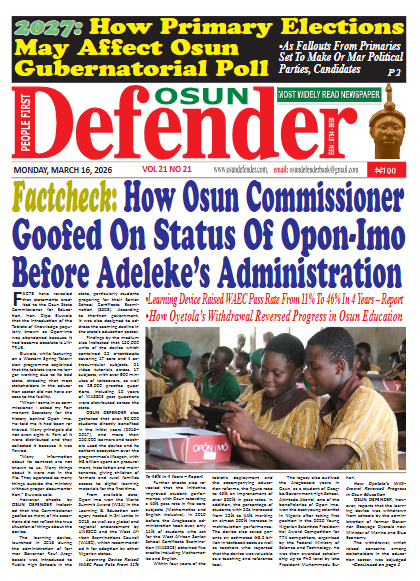

- Learning Device Raised WAEC Pass Rate From 11% To 46% In 4 Years – Report
- How Oyetola’s Withdrawal Reversed Progress in Osun Education
Facts have revealed that statements credited to the Osun State Commissioner for Education, Hon. Dipo Eluwole, that the introduction of the Tablets of Knowledge, popularly known as Opon-Imo, was abandoned because it had become obsolete is UNTRUE.
Eluwole, while featuring on a Western Spring Television programme, explained that the tablets were no longer working due to its bad state, stressing that most stakeholders in the education sector did not have access to the facility.
“When I came in as commissioner, I asked my Permanent Secretary for the history behind Opon Imo. He told me it had been retrieved. Many principals did not even sight it. Part of it were distributed and they collected it because it was flawed.
“Many information about its contract are not known to us. Many things about it were not in the file. They operated so many things outside the ministry without proper documentation,” Eluwole said.
However, checks by OSUN DEFENDER indicated that the Commissioner goofed, as many of his assertions did not reflect the true situation of things about the device.
The learning device, launched in 2013 during the administration of former Governor Rauf Aregbesola was introduced to Public High Schools in the state, particularly students preparing for their Senior School Certificate Examination (SSCE). According to the-then government, it was also designed to address the seeming decline in the state’s education sector.
Findings by the medium also indicated that 150,000 units of the device which contained 55 e-textbooks covering 17 core and 4 extracurricular subjects, 51 video tutorials across 17 subjects, with over 900 minutes of voiceovers, as well as 29,000 practice questions, including 10 years of WASSCE past questions were distributed across the state.
OSUN DEFENDER also gathered that over 90,000 students directly benefited in the initial years (2013–2017), and more than 250,000 learners and teachers used the device and its content ecosystem over the programmes’s lifespan, with ₦3 billion spent on procurement, installation and maintenance, giving children of farmers and rural families access to digital learning materials for the first time.
From available data, Opon Imo won the World Summit Award (WSA) in the Learning & Education category hosted in Sri Lanka in 2013, as well as a global and regional endorsement by UNESCO and the West African Examinations Council (WAEC), which recommended it for adoption by other Nigerian states.
- Learning Device Raised WAEC Pass Rate From 11% To 46% In 4 Years – Report
Further checks also revealed that the initiative improved student performance, with Osun recording a 46% pass rate in five core subjects (Mathematics and English inclusive). In 2010 before the Aregbesola administration took over, only 11% of students who sat for the West African Senior School Certificate Examination (WASSCE) obtained five credits, including Mathematics and English.
Within four years of the tablet’s deployment and the accompanying education reforms, the figure rose to 46% an improvement of over 300% in pass rates. In addition, the percentage of students with 5Cs increased from 15% to 44%, marking an almost 200% increase in matriculation performance. The device also saved parents an estimated ₦8.2 billion in textbook costs as well as teachers who reported that the device was valuable as a teaching and reference tool.
The legacy also outlived the Aregbesola years in Osun, as a student of Osogbo Government High School, Akintade Akanbi, one of the beneficiaries of Opon Imo, won the best young scientist in Nigeria after taking first position in the 2020 Young Nigerian Scientists Presidential Award Competition for 774 competitors, organised by the Federal Ministry of Science and Technology. He was then awarded a scholarship up to PhD level by late President Muhammadu Buhari.
- How Oyetola’s Withdrawal Reversed Progress in Osun Education
OSUN DEFENDER, however, reports that the learning device was withdrawn from schools by the administration of former Governor Gboyega Oyetola, now Minister of Marine and Blue Economy.
The withdrawal, which raised concerns among stakeholders in the education sector, was adjudged more political than visionary, as it further affected the rankings of the state’s students’ in local and foreign external examinations.
Some residents of the state also decried the move, stressing that the withdrawal reversed the progress achieved over the years in the state’s education sector.
A parent, Mrs Felicia Adeola, submitted that the sudden withdrawal of the tablets from students by the Oyetola administration impeded those who had made progress with it from fully optimising its benefits.
“The tablet was supposed to make things better. Some students had actually benefitted from it. But the withdrawal was sudden. It was just too political to have disallowed students who had started preparing for WAEC in 2020 and subsequently from its usage.
“You can see the results and how the education sector has dwindled since then. That is what we say when we demand good governance. Opon-Imo achieved a lot, but cutting it short hampered its lifelong projections,” Mrs Adeola said.
Similarly, Governor Ademola Adeleke carpeted the Oyetola administration on the withdrawal of Opon-Imo, saying it had increased the poor performance of students in SSCE Examinations, directing the revilitisation of the nine computer centres located in selected schools across the nine federal constituencies of the state, where more than 10,000 Youths trained under the O’YES-Tech Scheme were domiciled to handle technical and repair issues of the e-learning gadgets.
As at the time of filing this report, Adeleke, however, has yet to reintroduce the tablets.

Sodiq Yusuf is a trained media practitioner and journalist with considerable years of experience in print, broadcast, and digital journalism. His interests cover a wide range of causes in politics, governance, sports, community development, and good governance.
Related posts:
 FACTCHECK: How Adeleke Lied About Previous Govt Intervention On Cooperative Societies
 Osun Assembly Orders Status Quo On LG Administration
 From Tablet to Triumph: How Aregbesola’s “Opon Imo” Sparked A Young Osun Man’s Chess Journey
 Opon Imo: Students, Parents Eulogize Osun Govt as Distribution Continues