Falana Reveals How Abacha Regime Executed Ogoni 4, Ogoni 9
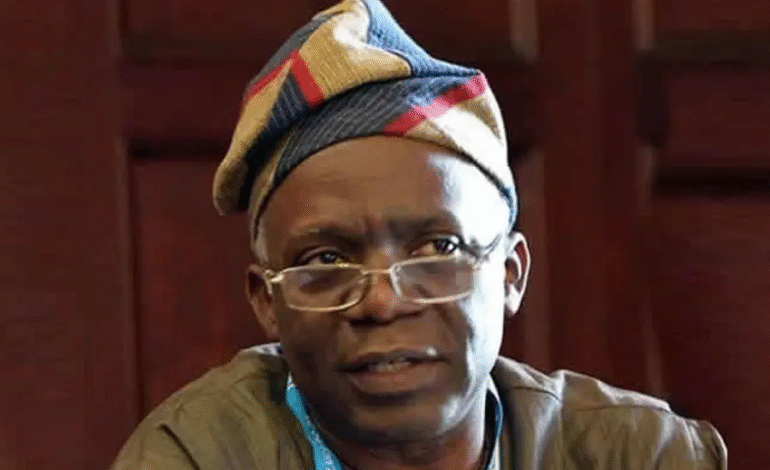

Human rights lawyer, Mr Femi Falana (SAN), has narrated how the late General Sani Abacha’s military junta brutally executed the Ogoni 4 and Ogoni 9 in 1995.
Speaking at the 84th posthumous birthday lecture of Ken Saro-Wiwa in Port Harcourt, Falana recalled that he and Chief Gani Fawehinmi (SAN) had defended Saro-Wiwa and other Movement for the Survival of Ogoni People (MOSOP) leaders, but withdrew from the case when a special military tribunal blocked them from presenting vital evidence.
According to Falana, “in a desperate bid to exploit the oil resources without control, Shell Petroleum Development Company was granted licences by the Nigerian State to import arms and ammunition into the country under the pretext of protecting its assets.
“The weapons were later found in the hands of militant youths as communities were instigated to attack and fight themselves. This was done to divert the attention of the people while the oil-rich region was fully exploited by Shell and other oil companies.”
He said that when Shell’s divide-and-rule tactics failed, the military task force led by Col. Paul Okuntimo recruited misguided militants to kill the Ogoni 4. “Hence, when the leaders were attacked and killed by the youths, the soldiers who were present at the scene of the crime did not make any arrest. The bodies of the deceased were taken away by the soldiers to an unknown place,” he added.
Falana revealed that after the killings, Col. Dauda Komo, then military governor of Rivers State, declared that Ken Saro-Wiwa and other MOSOP leaders would be held vicariously liable — even before any investigation began.
“The charge of murder filed at the High Court of Rivers State was discontinued when prosecutors told the junta that the evidence was too weak. Yet, on the orders of General Abacha, a special military tribunal was constituted. The tribunal rejected vital defence evidence to pave the way for the conviction and execution of the Ogoni 9,” Falana said.
On the execution, he explained, “Under Section 7 of the Civil Disturbances Decree, the Tribunal was required to furnish the PRC with the record of proceedings for confirmation or rejection of the conviction and sentences. But the Provisional Ruling Council purportedly confirmed the death sentences and gave orders for the secret execution of the Ogoni 9 when the tribunal had not compiled the record. It was on the basis of the illegality that Nigeria was suspended from the Commonwealth of Nations.”
Falana noted that the case was later reopened before the Oputa Panel on Human Rights Abuses under the Olusegun Obasanjo administration in 1999, where evidence proved that both the Ogoni 4 and Ogoni 9 were killed by the Abacha regime. “The panel proceeded to unite the family members of the Ogoni 13 before leaving Port Harcourt,” he said.
He added that it was based on the Oputa Panel’s recommendation that “the Bola Tinubu administration has deemed it fit to bring closure to the tragic incident and further unite the Ogoni people by granting pardon to the Ogoni 9 and conferring posthumous national honours on the Ogoni 13.”
Falana congratulated the Ogoni people and the Niger Delta region for achieving progress in their environmental struggle, citing gains such as the 13 per cent derivation fund under Section 162(2) of the 1999 Constitution.
He disclosed that between January and May 2025, the nine oil-producing states received a total of N620.23 billion from the Federation Account as derivation, but lamented that “since the humongous sums have not improved the lives of the people, MOSOP should lead a campaign for at least five per cent allocation to the oil-producing communities in every oil-producing state.”
Falana also highlighted Section 257(2) of the Petroleum Industry Act, which mandates oil and gas companies to remit three per cent of their annual operational expenditure to affected host communities.
He cited the Chief Executive of the National Upstream Petroleum Regulatory Commission (NUPRC), Mr Gbenga Komolafe, who confirmed that the Host Community Development Trusts had remitted over N358.67 billion to host communities as of October 2025, funding 536 ongoing projects including schools, health centres, roads, and vocational centres.
Titilope Adako is a talented and intrepid journalist, dedicated to shedding light on the untold stories of Osun State and Nigeria. Through incisive reporting, she tackles a broad spectrum of topics, from politics and social justice to culture and entertainment, with a commitment to accuracy, empathy, and inspiring positive change.
Related posts:
 Tinubu’s Regime Worse Than Abacha’s In Crushing Free Speech – Dele Farotimi
 ‘They Deserve Full Exoneration’, Amnesty International On FG’s State Pardon For KSW, Other Ogoni Nine
 Ogoni Diaspora Groups Reject Tinubu’s Posthumous Pardon For Saro-Wiwa, Others
 N/Grid Shutdown: Labour Overstepped Their Bounds, They Should Be Thankful We’re Not In Military Regime – Presidency