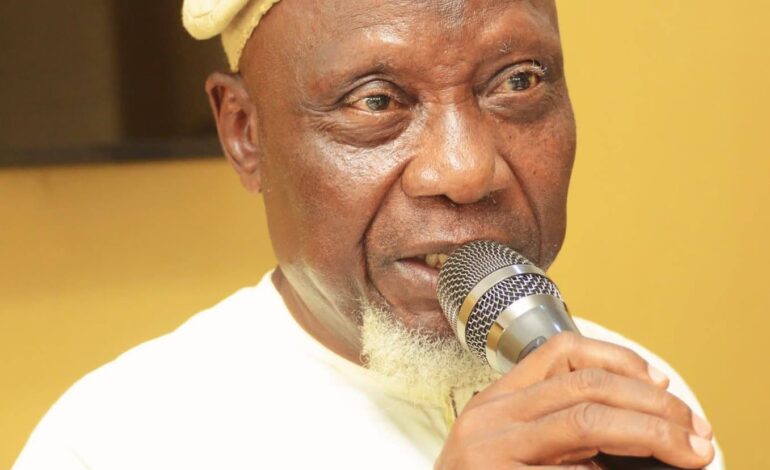


The chairman of the African Democratic Congress (ADC) in Osun State, Alhaji Azeez Adesiji, was a guest of the Nigeria Union of Journalists (NUJ), Osun State council, recently. The chairman featured on a guest personality programme organized by the union, where he granted an interview to a cross-section of Journalists at the programme.
In the interview, Alhaji Adesiji spoke about the ADC in Osun State, the forthcoming governorship election in the state and the chances of the ADC’s candidate, Dr. Najeem Folasayo Salaam, among other issues. He also gave clear reasons why the people of Osun State should vote massively for the ADC in the August 15 governorship election. Ibrahim Abdullahi captured the interview for Osun Defender. Excerpts:
Question: Your party recently unveiled a 10 point developmental agenda ahead of the governorship election. Many citizens have become skeptical of campaign promises. Why should Osun people believe that the agenda will be implemented?
Adesiji: The skepticism is understandable because many politicians have made promises in the past without delivering. However, our agenda is different because it is based on practical realities and not political fantasies. Every proposal contained in our manifesto has been carefully studied and linked to available resources, economic opportunities and measurable outcomes.
We intend to improve Internally Generated Revenue, attract private-sector investments and strengthen accountability in public spending. Our focus is not merely to make promises but to establish systems that guarantee implementation. The people of Osun deserve a government that works for them and that is exactly what ADC is offering.
Question: Workers’ welfare is the first item on your agenda. What should civil servants expect under an ADC administration?
Adesiji: Workers remain the engine room of government. A government that fails to prioritize its workforce cannot achieve meaningful development.
Our administration will ensure prompt payment of salaries and pensions. We will also improve housing and vehicle loan schemes, provide regular promotion opportunities, and create a better working environment for public servants.
I have always maintained that workers deserve respect and dignity. During difficult economic periods, governments must seek solutions that protect jobs rather than throw people into unemployment. We will continue to pursue policies that place workers’ welfare at the center of governance.
Question: Recently, you defended the salary arrangement introduced during the administration of former Governor Rauf Aregbesola. Why was that important?
Adesiji: There has been a misconception about what happened during that period. Many people continue to describe it as payment of half salaries, but that is not entirely correct.
A committee involving labour representatives and government officials was established to find a solution to the economic crisis facing the state at the time. The decision reached was salary modulation rather than retrenchment.
Workers on Grade Levels 1 to 7 received their full salaries. Those on Grade Levels 8 to 12 received three-quarters of their salaries, while Grade Level 13 and above, including political office holders, received half salaries.
The objective was simple: protect jobs and prevent mass retrenchment. The administration chose to keep workers employed despite severe financial challenges. That context is often ignored when discussing that period.
Question: Digital governance appears prominently in your manifesto. What exactly does that mean?
Adesiji: Digital governance simply means making government more efficient, transparent, and accessible.
We want to reduce unnecessary bureaucracy and ensure that government services can be accessed through modern technology. Processes such as recruitment, procurement, documentation, and public service delivery should be transparent and easily monitored.
By embracing technology, government can reduce corruption, improve efficiency, and provide faster services to citizens.
Question: Accountability has become a popular campaign slogan among politicians. What makes ADC different?
Adesiji: The difference is that we intend to institutionalize accountability.
Public funds belong to the people and must be managed responsibly. We will strengthen audit mechanisms, improve procurement procedures, and ensure that government spending is subject to proper oversight.
Transparency should not depend on the goodwill of an individual leader. It should be embedded in the structure of governance itself.
Question: Local government autonomy remains a major national conversation. What is your position?
Answer: We fully support local government autonomy because development is more effective when governance is brought closer to the people.
Local governments should have the capacity and freedom to address local challenges. Communities understand their priorities better than anyone else, and government structures should reflect that reality.
Question: Security appears to be one of your major concerns. You recently described it as the biggest challenge facing Osun State. Why?
Adesiji: Because security affects every aspect of development. Without security, businesses cannot thrive, farmers cannot cultivate their lands, investors will stay away and citizens cannot live peacefully.
The lives of our youths are very important to us. We will strengthen community-based security systems, improve intelligence gathering, invest in surveillance technology, and collaborate closely with security agencies, traditional rulers, and community leaders.
We must also address unemployment and social exclusion because they often contribute to insecurity.
Question: Agriculture occupies a prominent place in your agenda. How can Osun become an agricultural powerhouse?
Adesiji: Agriculture is one of the fastest ways to stimulate economic growth and create jobs.
We intend to establish farm settlements, support mechanized farming, provide access to improved seedlings and fertilizers, and strengthen agro-processing industries.
The goal is to move beyond subsistence farming and create a commercial agricultural sector capable of feeding our people and generating revenue.
Question: Education remains a concern for many families. What reforms are you proposing?
Adesiji: Education is the foundation of development.
We will strengthen free basic education, recruit qualified teachers, rehabilitate schools, and improve learning facilities.
Scholarship and bursary programs will be expanded, while vocational and ICT training will receive greater attention. Young people must be equipped with skills that are relevant to today’s economy.
Question: Infrastructural projects require substantial funding. How do you intend to finance them?
Adesiji: Government resources alone are not enough. We will leverage public-private partnerships and other innovative financing models.
Our priorities include roads, electricity, water supply, rural development, and urban renewal projects. Infrastructure investments will be guided by economic impact and long-term sustainability.
Question: Youths often complain about exclusion from governance. What role will they play under your administration?
Adesiji: Youth inclusion is not negotiable for us.
ADC has already reserved significant opportunities for young people within our political structure. We are committed to ensuring that young people participate actively in governance, policy development, and economic planning.
We will create jobs through entrepreneurship programs, ICT hubs, vocational training centres, and investment initiatives designed specifically for young people.
The future belongs to them, and they must have a seat at the table.
Question: You have also spoken about women empowerment. What practical measures are being proposed?
Adesiji:Women are critical partners in development.
Our party is committed to ensuring 35 percent inclusion for women in governance and public appointments. Beyond political participation, we will provide access to credit facilities, skills acquisition programs, and support for women-owned enterprises.
Empowering women strengthens families, communities, and the economy.
Question: Culture and tourism are often overlooked. Why are they important to ADC?
Adesiji: Osun possesses enormous cultural and tourism potential.
Our festivals, heritage sites, arts, music, and creative industries can generate employment and attract investment.
Tourism is not merely about entertainment; it is an economic sector capable of creating wealth and promoting the state’s identity globally.
Question: ADC appears closely associated with former Governor Rauf Aregbesola. What role does he play in the party’s current political movement?
Adesiji: Aregbesola remains an important political figure with a large followers and significant contributions to public service.
Part of our mission is to demonstrate the political relevance, influence, and value of his movement and supporters. His political experience and grassroots network remain important assets.
Question: There has been public discussion about the relationship between Aregbesola and President Bola Tinubu. What is your view?
Adesiji: Both individuals have made their contributions to Nigerian politics.
Aregbesola was politically active long before many people knew him nationally, and he played important roles throughout his political journey. Whatever differences may exist between them are matters best left to God and time.
Our focus remains on delivering good governance for the people.
Question: Political violence often accompanies elections. What message does ADC have for supporters?
Adesiji: We reject violence completely.
Politics should be about ideas, not intimidation. We appeal to all political parties and their supporters to conduct themselves peacefully before, during, and after the election.
The people must be allowed to make their choices freely. ADC remains committed to lawful and peaceful political engagement.
Question: Finally, why should Osun people vote for ADC?
Adesiji: Because we are offering a practical roadmap for development.
Our agenda focuses on workers’ welfare, security, agriculture, education, healthcare, infrastructure, youth empowerment, women inclusion, digital governance, tourism, and economic growth.
We are presenting solutions, not slogans. We believe Osun can achieve greater progress, and we are ready to provide the leadership required to make that vision a reality.
Related posts:
 Ex-Council Boss, Adesiji Emerges Osun ADC Chairman
 Osun Guber: Federal Might, Power Of Incumbency Will Fail, ADC Guber Candidate Declares
 Ekiti Guber Poll: INEC, Security Agencies Warn Against Vote Buying, Election Violence
 Osun Govt Pressures NUT Chairman To Resign Over Interview With OSUN DEFENDER