Knocks As Osun Public School Students Sing Political Songs At Assembly Ground
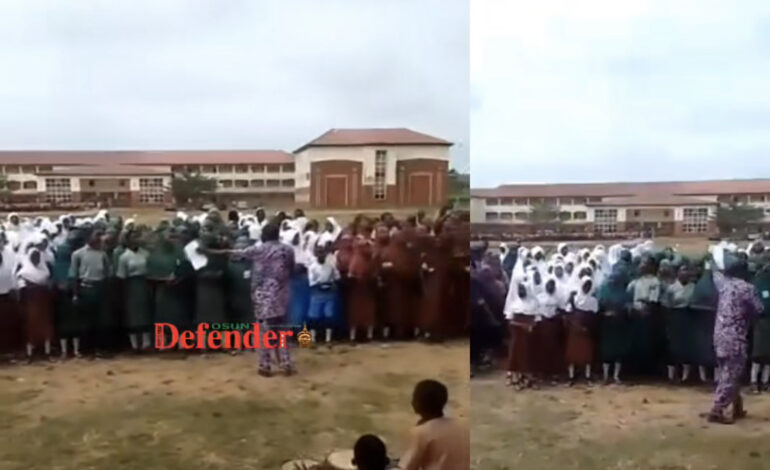

A video showing public school pupils in Osun State singing a song perceived as a campaign chant in support of Governor Ademola Adeleke has sparked intense reactions across social media and within public discourse.
The viral footage, reportedly recorded at an assembly in one of the state public schools, captures a group of young, school-aged children chanting lyrics that many viewers interpret as urging members of the public to vote for Governor Adeleke ahead of the next governorship election.
While some Nigerians have condemned the involvement of minors in partisan activities, others have defended it as a long-standing political practice in the country, with a few offering nuanced or opposing perspectives.
Critics Condemn Involvement of Children
A large number of reactions criticised the action, describing it as inappropriate and exploitative.
Dele Dosumu questioned the moral justification for involving children in politics, asking, “Were the politicians’ children involved in this kind of nonsense? Children of the masses are suffering in this country. Do they even have a conducive learning environment? This may affect their intellectual development.”
Similarly, Akeem Adebayo warned of consequences, saying, “What goes around will surely come around. It’s a question of time. These little children shouldn’t have been involved in this power game.”
Other critics echoed similar sentiments. Rasheed Jamiu Babatunde asked, “Why involving minors into politics?” while Ola Wale lamented, “Chai, this is very bad. Is this what they are learning in school now?”
Adeyemi R. Babalola also expressed confusion over the exercise, asking, “What’s the meaning of all this now? So these underage children will vote for Ademola or what?”
Abdulateef Salahudeen alleged coercion, stating, “They forced them to do that. Kin lomode mo (children are naïve).”
Oluwaseun Adewale added, “I disagree with this practice. Please let these children be. As a teacher, chai, it is wrong.”
Supporters Defend the Practice
On the other side, some commenters played down the outrage, describing the incident as normal within Nigeria’s political culture.
Prince Abiodun Oyewo dismissed the criticism, saying, “Na normal thing. The question should be whether their parents will replicate the same support with PVC.”
Olubunmi Olaniyi, though less detailed in argument, defended the act in a religious tone, saying, “They like suffering and smiling. God will not allow you.”
A third group neither fully supported nor outrightly condemned the incident but provided historical or contextual explanations.
Abiola Kolawole noted that while he does not support the act, it follows an established pattern. “It is the precedent set by the previous administration,” he said. “If you look inwardly, you’d notice that even the judiciary at the national level sings the anthem of the President. What’s good for the goose is also good for the gander.”
Olaniyan Wale also recalled past experiences, saying, “This act isn’t new in Nigeria. During the era of Baba Awolowo, it happened. I remember vividly when we were told to line up in our school uniforms and sing for him during his political tour.”
Ayodeji Salah drew parallels with recent events in another state, noting, “When Remi Tinubu visited Kwara State, the state government took schoolchildren out during school hours to wave at her.”
Hafsoh Isiaq is a graduate of Linguistics. An avid writer committed to creative, high-quality research and news reportage. She has considerable experience in writing and reporting across a variety of platforms including print and online.
Related posts:
 Will Smith To Sing Official Song For The 2018 World Cup In Russia
 Nigerian Man Set To Break Guinness World Record, Begins 110-Hour Sing-A-Thon
 Osun Public School Students Emerge Winners Of Redeemers University Quiz Competition
 FEATURE: Inside Osun Public School Where Parents Pay To Hire Teachers For Students