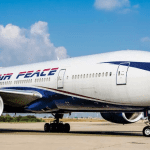
NCAA Explains Why Air Peace Co-Pilot Was Cleared Despite NSIB Report



The Nigerian Civil Aviation Authority has defended its decision to clear the Air Peace co-pilot accused in a recent safety controversy, insisting he was not indicted by its internal findings or the Nigeria Safety Investigation Bureau’s preliminary report.
The incident occurred on June 13 when an Air Peace aircraft veered off the runway after landing at the Port Harcourt International Airport.
The NSIB later revealed that the plane had touched down 2,264 metres from the runway threshold, beyond the recommended zone, before coming to a stop 209 metres into the clearway.
Following a medical test, the NSIB indicted the crew over alleged traces of alcohol and drugs, but the NCAA’s Director of Public Affairs and Consumer Protection, Michael Achimugu, clarified during an X space on Saturday that the co-pilot was never found culpable.
“I learnt yesterday that the NCAA was being blamed for giving clearance to the first officer. But based on the NCAA internal findings and the NSIB preliminary report, the co-pilot was not found culpable. In fact, he advised the captain to go around, which the captain did not heed. It would be unjust to ground him for a year without evidence of wrongdoing,” Achimugu said.
He stressed that NCAA regulations undergo regular reviews and that airlines are expected to submit compliance reports on their internal safety measures.
He also confirmed that the agency follows international procedures for post-incident assessments using NCAA-approved centres.
Achimugu added that some inconsistencies in the NSIB’s report had been flagged and that the NCAA’s Director General, Capt Chris Najomo, who just returned to the country, would address the matter formally.
During the discussion, aviation stakeholder Bamidele Badmos raised concerns about the airline’s handling of the incident, warning that Nigeria’s Bilateral Air Services Agreements could be jeopardised if such issues are not treated with seriousness.
“This industry operates on very high standards. Once an infraction occurs, caution must be exercised immediately. The rules are clear; they are not optional. If someone is found wanting, it’s not a time to start defending or raising unnecessary alarms,” Badmos said.
He cautioned airline personnel against making informal media appearances to defend the airline or challenge regulators, urging that such matters be handled only through official channels.
Titilope Adako is a talented and intrepid journalist, dedicated to shedding light on the untold stories of Osun State and Nigeria. Through incisive reporting, she tackles a broad spectrum of topics, from politics and social justice to culture and entertainment, with a commitment to accuracy, empathy, and inspiring positive change.