New Tax Laws May Push Airfares to N1.7m – Air Peace CEO



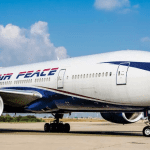
Air Peace Chairman and Chief Executive Officer, Allen Onyema, has warned that Nigeria’s domestic aviation industry is on the brink of collapse, saying newly introduced tax laws could push airfares beyond N1m and force airlines out of business within months.
Speaking in an interview on Sunday, Onyema said that unless the policy is urgently reviewed, the consequences would be severe for passengers, airlines, financial institutions, and the wider economy.
He said Nigerian airlines are weighed down by excessive taxes, levies, and statutory charges, arguing that operators are unfairly portrayed as profiteers despite receiving only a fraction of ticket revenue.
“Taxes, levies, and all manner of charges heavily overburden the Nigerian airlines. Just take a ticket of about N350,000. What comes to the airlines is about N81,000. And people, everybody’s talking about the airlines as if they’re making a kill. It’s not true.”
Onyema faulted what he described as multiple and overlapping deductions imposed on airlines, including a mandatory five percent charge on every ticket sold.
“We are suffering multiple taxation, multiple charges. For example, the NCAA, five percent for every ticket, is mandatory. That is to NCAA alone. There are so many other charges.”
According to him, the charges run contrary to international aviation standards and ultimately depress passenger demand.
“ICAO, the International Civil Aviation Organisation, says that you are not supposed to go into revenue-generating for the government. What you do is cost recovery.”
He explained that global aviation best practice supports cost recovery based strictly on services rendered, not revenue generation.
“That is, you charge according to the cost of the services you render to the airlines. Who are the ones suffering? The airlines. And that’s why the airlines are not growing.”
Onyema recalled that the 2020 tax law provided significant relief to the aviation sector by removing customs duties and VAT on imported aircraft, spare parts, engines, and ticket fares.
“Now, the tax law of 2020 removed customs duties on imported aircraft and imported aircraft spares and engines, removed VAT on imported aircraft and other spare parts, and removed VAT on ticket fares. That is the 2020 Act.”
He said despite those concessions, airlines continued to struggle with multiple charges nationwide, adding that the new tax law has reversed the gains.
“Even then, airlines are still suffering from so many other multiple charges all over the country. Now, the new tax law has brought those things back. All of them.”
Onyema said the reintroduction of a 7.5 percent VAT on aircraft and spare parts importation would sharply raise operating costs.
“There’s VAT now on the importation of aircraft. So if you buy an aircraft for $80m, you are supposed to pay 7.5 percent of $80m.”
He added that renewed taxation combined with high borrowing costs makes airline operations unsustainable.
“Funds borrowed from the bank are 30–35 percent. So you bring in spare parts, you pay 7.5 percent on your spare parts. Ticket fares will hit $1.7m soon. At 35 per cent we are choking. You don’t do that.”
Warning that the burden would be passed on to passengers, Onyema predicted unprecedented increases in domestic airfares if the policy is fully implemented.
“Because when you take 5 percent from what we charge, it reduces the demand. With this new tax regime? Yes. From January.
“With 7.5 percent on ticket fares, ticket fares will hit N1.7m soon. If we implement that tax reform, Nigerian airlines will go down in three months. At the end of the day, economic class tickets will go to about N1.7m if it happens.”
He said airline operators under the Airline Operators of Nigeria had repeatedly submitted their concerns to relevant authorities, including the National Assembly and the tax reform committee.
“We submitted, nobody listened to us. In fact, to be honest with you, the AON, the operators, airline operators, I led them, we went to the National Assembly. We addressed them on this issue and they saw reasons with us. They were surprised by the kind of facts we’re bringing out.”
Onyema said lawmakers and government consultants later acknowledged the risks after engaging with operators.
“We went to the tax consultant the government hired, the chairman of the task force. He gave us an audience. He agreed with us. He was even worried.”
Describing aviation as a catalyst for economic growth and national integration, Onyema said the sector should not be treated as a revenue source.
“One thing I credit this regime for is that our president is a businessman and from what I know, he doesn’t want indigenous businesses to crumble.
“When it comes to the airline business, it’s a peculiar one. Airlines all over the world are supported by governments, even private airlines. We’re not asking them to give us money, even though in other climes they are giving money.”
He urged the Federal Government to revert to the 2020 Aviation Act, which he said recognised and respected the peculiar nature of the industry.
Titilope Adako is a talented and intrepid journalist, dedicated to shedding light on the untold stories of Osun State and Nigeria. Through incisive reporting, she tackles a broad spectrum of topics, from politics and social justice to culture and entertainment, with a commitment to accuracy, empathy, and inspiring positive change.