Nigeria Still At War With Ndigbo – Gen Ijioma
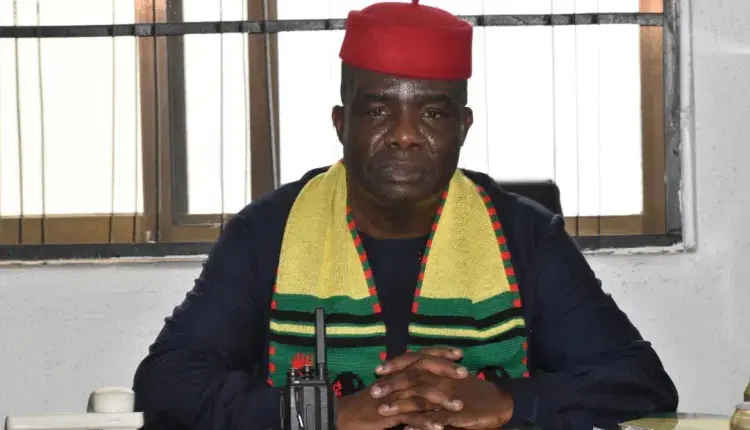

Major General Ijioma Nwokoro Ijioma (retd.) has lamented that 55 years after the Nigerian civil war, the country is yet to forgive and fully integrate the Igbo people.
Speaking as a guest at the July edition of Ikengaonline’s virtual town hall meeting, Gen. Ijioma expressed shock that despite the efforts and commitment of the Igbos to Nigeria’s unity and progress, they are still treated as outsiders.
“Our people at the end of the war wholeheartedly wanted to be reintegrated into Nigeria and have done everything possible to convince Nigerians that we are Nigerians, but I want to observe that despite these efforts, it seems that there is an agreement by Nigerians that the war hasn’t ended,” he said.
The retired general described the popular “No victor, no vanquished” slogan after the war as mere rhetoric, insisting that the realities on the ground show the Igbos are still seen as conquered people.
“Nigeria is still at war against Ndigbo. My 33 and a half years in the Army, rising to the rank of Major General, has taught me that the rest of Nigeria have not forgiven Ndigbo. My experience in service convinced me that the rest of Nigeria have not accepted that the war ended in 1970. So there is a war against Ndigbo,” he stated.
Gen. Ijioma likened the situation to a family where six siblings gang up against a stronger one to subdue and exploit him. He argued that this has been Nigeria’s approach to the Igbos.
He also questioned why Nigeria finds it difficult to trust an Igbo person with the presidency, while other major tribes have had their share of leadership.
“If President Tinubu runs his second course in 2027, that will be eight years. Then add it to eight years of former President Obasanjo, making it 16 years for the Yoruba nation. Add it to the six years of Jonathan, and eight years of Buhari, that is 30 years and these were 30 years of political exclusion. By 2031, the presidency goes to the North and if you take another eight years you are talking about a total of 38 years of continued exclusion of Igbo from the Nigerian presidency,” he explained.
The retired general noted that the end of the war negatively impacted the Igbos across various sectors, including business, academics, and the military. He accused the Nigerian state of being afraid of the Igbos despite their commitment to the country’s progress.
“I don’t just claim Ndigbo are the true Nigerians, but in theory and in practice we are the true Nigerians. The development Nigeria has made is as a result of the effort of Ndigbo. I will dare you and I will challenge you to show me an Hausa man in Igbo land developing it as we do outside Igbo land,” he said, adding that 25 per cent of properties in Lagos belong to the Igbos.
Gen. Ijioma blamed the Igbo political elite, especially South-East governors, for failing to advance the collective interest of their people.
“Ndigbo must unite to overcome the gang-up against them. Our divisive and individual nature are our vulnerability. We must consciously look for a way of uniting so that in unity, our voice will be stronger,” he said.
He traced the decline of Igbo political influence to the emergence of the All Progressives Congress (APC), noting that the Igbos had stronger political clout when united under the Peoples Democratic Party (PDP).
“Look at the five southeastern states. When we were in PDP, were we not much stronger and was our voice not louder? Were we not respected? Now that you have APC crawling in and taking two states, you have Labour, you have PDP struggling in Enugu and APGA in Anambra. Is there any doubt to anybody why our status has gone miserable? It’s because of division,” he added.
Going down memory lane, Gen. Ijioma described 1956 to 1966 as the “golden and glorious stage” of Igbo politics, while labelling 2015 to 2025 as the “worst and most shameful time” for the Igbos in Nigeria’s political history.
He called for a re-examination of Igbo value systems, urging the people to hold their political leaders accountable and prioritise integrity in leadership.
“I dare say and challenge Igbos that with about 65 million people that make up the 200 million in Nigeria, the Igbos with marginal support from other regions can put one of their own kind in the presidency come 2027,” he declared.
According to him, unity and collective action are the only way for the Igbos to reclaim their place in Nigeria’s political landscape.
Titilope Adako is a talented and intrepid journalist, dedicated to shedding light on the untold stories of Osun State and Nigeria. Through incisive reporting, she tackles a broad spectrum of topics, from politics and social justice to culture and entertainment, with a commitment to accuracy, empathy, and inspiring positive change.