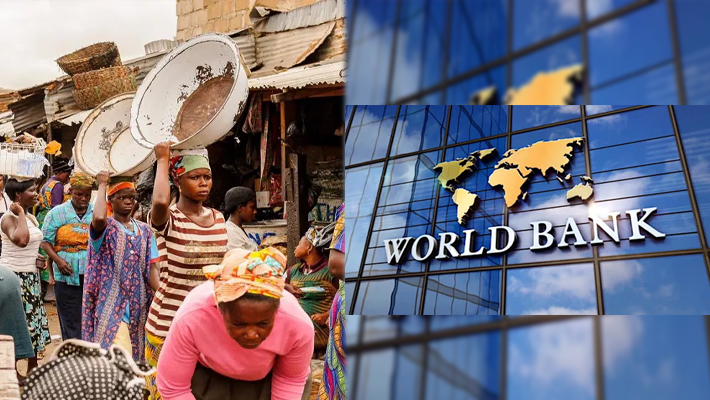

World Bank’s Africa’s Pulse report of April 2025 has stated that Nigeria, under President Bola Tinubu, has the highest number of extremely poor people globally.
According to a chart in the report, Nigeria accounts for 19 per cent of extremely poor people in Sub-Saharan Africa, while the Democratic Republic of Congo has 14 per cent, Ethiopia 9 per cent, and Sudan 6 per cent.
“Sub-Saharan Africa has the highest extreme poverty rate globally, and a large share of the poor is concentrated in a few countries,” the report stated.
It added, “About 80 per cent of the world’s estimated 695 million extreme poor resided in Sub-Saharan Africa in 2024, compared to 8 per cent in South Asia, 2 per cent in East Asia and the Pacific, 5 per cent in the Middle East and North Africa, and 3 per cent in Latin America and the Caribbean.”
A further breakdown by Peoples Gazette shows that Nigeria’s 19 per cent of the 560 million extremely poor in Sub-Saharan Africa represents 106 million people. This also amounts to 15.25 per cent of the world’s estimated 695 million extremely poor.
The report lists Nigeria, the Democratic Republic of Congo, Ethiopia, and war-torn Sudan as the four countries “within Sub-Saharan Africa, with half of the 560 million extreme poor in 2024.”
The World Bank also predicted a grim future for Nigeria, stating that more Nigerians will be plunged into poverty under Mr Tinubu’s watch by 2027.
It would be recalled that the International Monetary Fund (IMF) last week, said that Tinubu’s economic policies are yet to yield tangible benefits for Nigerians, as poverty and food insecurity remain widespread.
The IMF said though reforms introduced by the Tinubu-led government “have put the Nigerian economy in a better position to navigate this external environment,” the country still faces economic uncertainty.
“The outlook is marked by significant uncertainty. Elevated global risk sentiment and lower oil prices impact the Nigerian economy. Looking ahead, macroeconomic policies need to further strengthen buffers and resilience, while creating enabling conditions for private sector-led growth,” the IMF said.

Olamilekan Adigun is a graduate of Mass Communication with years of experience in journalism embedded in uncovering human interest stories. He also prioritises accuracy and factual reportage of issues.