“No Democracy Thrives Without Competition”, El-Rufai Cautions Tinubu On Gale Of Defections
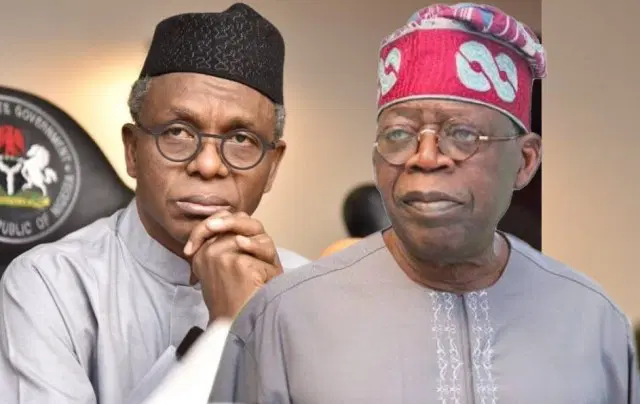


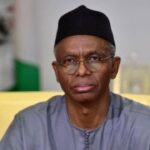
Former Kaduna State Governor, Nasir El-Rufai, has raised alarm over what he described as a growing attempt to weaken Nigeria’s democratic space ahead of the 2027 general elections, warning that democracy cannot survive without genuine political competition.
El-Rufai stated this in a political commentary titled “Democracy Without Competition? – Nigeria and the Road to 2027,” dated January 26, 2026, where he criticised the rising wave of defections from opposition parties and what he termed the systematic erosion of political pluralism in the country.
OSUN DEFENDER reports that the year 2025 saw a significant realignment of political loyalties among state governors elected on opposition platform including Umo Eno of Akwa Ibom, Sheriff Oborevwori of Delta, Peter Mbah of Enugu, and Douye Diri of Bayelsa; defecting to the ruling All Progressives Congress (APC).
Most strikingly, Governor Peter Mbah’s defection in October 2025 effectively marked the exit of the last PDP governor in the South-East from the party he once led, reshaping the political landscape in that region.
The latest in this trend came yesterday when Governor Abba Yusuf of Kano State officially joined the APC, alongside a majority of his state lawmakers and other political officeholders in a move he described as being “in the best interest of the people of Kano.”
El-Rufai argued that Nigeria’s Fourth Republic, since 1999 has been sustained largely by competitive politics, despite its imperfections. He noted that the defeat of an incumbent ruling party in 2015 and the keenly contested 2023 elections demonstrated that political contestation remains central to Nigeria’s democratic endurance.
“As I noted recently at the Daily Trust Dialogue, this democratic endurance constitutes a credit not only to politicians and parties but to the ordinary Nigerian and is indeed a cause for national celebration,” El-Rufai said.
However, he expressed concern that recent developments suggest a deliberate move towards what he called “a democracy without competition,” characterised by elections without real choice and power without legitimacy.
El-Rufai accused the ruling All Progressives Congress of aggressively pushing Nigeria towards a one-party state by pressuring opposition governors and political actors to defect through inducements and intimidation.
“Governors, legislators, and political actors are being ‘persuaded’ to defect not by ideology or performance, but by fear and survival instinct,” he said, adding that the resulting defections reflect “democratic distress rather than political convergence.”
The former governor also warned against what he described as the weaponisation of state institutions, alleging that security agencies and law enforcement bodies are increasingly being used to harass and intimidate opposition figures.
“Agencies endowed with extraordinary coercive powers—intended to protect the state—are being pressured to target opposition politicians,” he said, noting that such actions undermine the rule of law and public trust in democratic institutions.
Drawing parallels with other African countries, El-Rufai cautioned Nigeria against embracing a model of “managed democracy” where ruling parties win elections by implausible margins.
“Democracy without competition is not stability, it is stagnation. Elections without choice do not confer legitimacy; they merely postpone reckoning,” he warned.
He further argued that democratic erosion carries serious economic consequences, including reduced investor confidence, weakened institutions, and increased uncertainty in key sectors of the economy.
In his piece, El-Rufai referenced several past statements credited to President Bola Ahmed Tinubu during his years as an opposition leader, particularly a 2011 speech at Chatham House in London.
“We cannot talk about the vitality of Nigerian democracy without talking about the vitality of the political opposition. For there is no democracy without diversity in substantive opinion and political affiliation,” Tinubu was quoted as saying at the time.
El-Rufai urged President Tinubu to uphold those principles in office by protecting political freedoms and ensuring a level playing field ahead of the 2027 polls.
“As president, he has a duty to follow this sterling path and use his powers and influence to secure for our country a vibrant, competitive democracy,” he said.
Concluding, El-Rufai said Nigeria stands at a crossroads as 2027 approaches, stressing that silencing opposition voices would amount to a betrayal of the Constitution and the country’s future.
“Democracy with competition is not a threat to Nigeria’s stability, but its surest foundation,” he added.
Hafsoh Isiaq is a graduate of Linguistics. An avid writer committed to creative, high-quality research and news reportage. She has considerable experience in writing and reporting across a variety of platforms including print and online.