Osun Communities Consent To End FGM, Expose Perpetrators
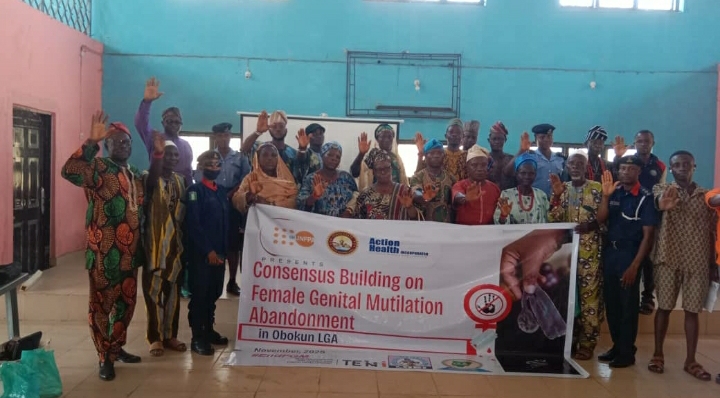


Residents of six communities in Obokun Local Government Area of Osun State, have vowed to end Female Genital Mutilation in their domain and also follow legal procedures in dealing with cases of female circumcision.
The communities are – Coker, Otan Ile, Oduola, Boredun, Oniyere and Otuuru.
The residents made the pledge on Thursday after their community leaders, alongside security personnel in the local government, signed the consensus-building document on the abandonment of Female Genital Mutilation.
The communities had earlier been sensitised on the dangers of female circumcision during dialogue meetings organised by a Non-Governmental Organisation, Action Health Incorporated (AHI), with the support of the United Nations Population Fund (UNFPA).
The consensus building programme was conducted by three community-based organisations in Osun state selected by AHI to support the anti-FGM implementation in project communities.
The organisations are – Mowalek Centre for Sustainable Community Development, TEMI Foundation for Women & Youth Development and
Livingspring Human Development Initiative.
The representatives of the communities, who included traditional chiefs, women and market leaders, while speaking during the consensus-building held at Ilase-Ijesa town hall, agreed to ensure the eradication of FGM in their respective communities.
Addressing the participants, the Programme Manager, TEMI Foundation for Women and Youth Development, Aderemi Olubummo, harped on the need to work together to end the menace of female circumcision in the six communities.
READ ALSO
•Osun First Lady, Others Call For FGM Offenders’ Prosecution
•Rep Demands Abolition Of BSC/HND Dichotomy
Olubummo said over 1 million girls are still being circumcised every year, adding that FGM has no advantage and only causes future problems for the victims.
Over 1 million females are still being mutilated yearly, and this is very sad. There is no advantage in female circumcision. The only thing we have is future dangers.
“FGM is not a way of stopping someone from being promiscuous. Those who are still engaging in the act are only endangering the victims but we have educated the communities and made them understand the right channel to report and punish the offenders,” Olubummo added.
Also, the Executive Director, Livingspring Human Development Initiative, Ezekiel Ejalonibu, highlighted the objectives of the consensus building activity.
According to him, the major reason was for all six communities to come together and agree on ways to end Female Genital Mutilation in their domain.
He said: “The main objective of the programme is to come together as a community and arrive at a basic way on how to put an end to Female Genital Mutilation.
“We also come up with community-made sanctions for those who engage in female circumcision. We know there are already laws and sanctions guiding against FGM; nevertheless, if we have community-made rules, it will also assist in ending the menace.”
Speaking with journalists after the signing of the consensus document by the participants, the Chief Executive Officer, Mowalek Centre for Sustainable Community Development, Mr Michael Olusesi, appreciated the United Nations Population Fund and Action Health Incorporated for giving the organisations the opportunity to engage with the communities.
Olusesi who said the communities had earlier declared to end the practice of Female Genital Mutilation in their area, noted that their representatives have documented their decisions through the signing of the consensus document.
He disclosed that the organisations familiarise the communities with the laws guarding against female circumcision in the state, adding that the security operatives present have also vowed to work with the communities and apprehend anyone found culpable.
He said, “The kings from the six communities were represented, and they all agreed and signed the consensus-building document that they will work to end FGM and follow the legal procedures.
“We have laws against Female Genital Mutilation in Osun, and we have explained these laws to the communities, and our security personnel have also promised to work with the communities to ensure those who are still engaging in the act are apprehended and made to face the law.
“Laws lie the Criminal Code, Capital 34, Vol. II, Laws of Osun State; Osun State Female Circumcision and Genital Mutilation (Prohibition) Law, 2004 and the Child Rights Law, 2007, are on ground to punish whoever engages in female circumcision in the state.
“We must make sure we punish the offenders in order to serve as a deterrent to others who are planning to engage in this harmful act. These laws are implementable, provided that Stakeholders can come together and speak in one voice. Security agencies have a lot to do and they must assist in eradicating this menace.”
The community chief (Baale) of Oniyere community, Chief Monrufu Abolaji, said the leaders from all six communities have agreed to ensure that there is no practice of Female Genital Mutilation in their domain.
Chief Abolaji appreciated Action Health Incorporated and the community-based organisations for the sensitisation, adding that they were more equipped on FGM than before.
Olamilekan Adigun is a graduate of Mass Communication with years of experience in journalism embedded in uncovering human interest stories. He also prioritises accuracy and factual reportage of issues.