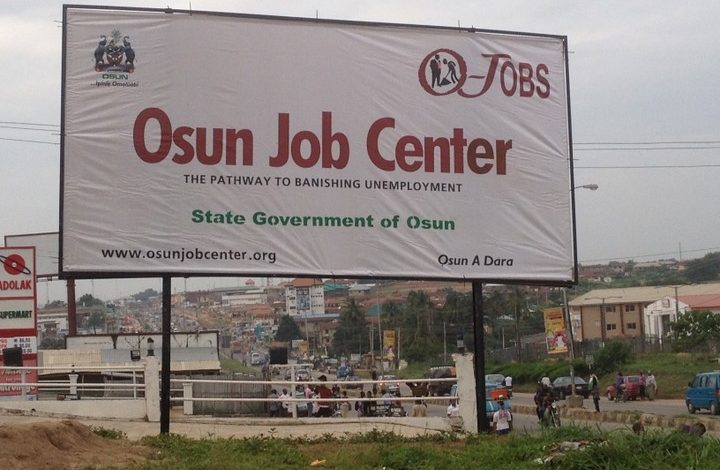
Osun Job Centre As Part Of Aregbesola’s Policies And Its Importance


- By Wahab Abiona
The establishment of the Osun Job Centre under the administration of Ogbeni Rauf Aregbesola was a strategic intervention aimed at addressing unemployment and underemployment in Osun State. Recognising that job creation extends beyond government employment, the centre was designed as a hub where job seekers could connect with opportunities, acquire employability skills, and receive career guidance.
This initiative reflects a proactive approach to labour market challenges by bridging the gap between job seekers and employers, while also promoting entrepreneurship and vocational training.
I found this idea more worthy when I got to United Kingdom, and I was searching for job and I was recommended to visit Job centre. I quickly recalled Ogbeni introduced something similar in Osun. My orientation and thoughts about all his Social Security Schemes came to my mind the more as I progress in United Kingdom.
The Job Centre became a cornerstone of Aregbesola’s broader social and economic policies, and why Ogbeni Rauf is a unique personality when it comes to governance, because of his international standards and initiative. His administration understood that youth unemployment posed both economic and social risks. By institutionalizing a structure that provided information on available vacancies, facilitated skills acquisition, and improved access to work-related resources, the Osun Job Centre streamlined recruitment processes and reduced information gaps in the labour market. It also fostered workforce readiness in alignment with private sector demands.
In developed economies such as the United Kingdom and the United States, similar models exist in the form of Job Centre Plus (UK) and American Job Centre (USA) amongst other developed Nations. These institutions serve as pillars of employment services, offering training, job matching, and benefits advisory. They integrate digital platforms to expand outreach, ensuring efficient matching of skills to opportunities. For instance, the United kingdom, Job Centre Plus helps individuals transition from welfare into work, while American Job Centres provide skill-building and workforce development programs supported by government funding.
The Osun Job Centre mirrors these international models by creating a system that not only supports job matching but also equips individuals with skills for a dynamic labour market. Its establishment signals the state’s recognition of employment services as a developmental priority. While smaller in scale compared to the United Kingdom or United States of America, it demonstrates how structured labour market policies can foster inclusive growth in developing contexts.
The Osun Job Centre model offers a blueprint that, if scaled across Nigeria, could reinvent employment opportunities nationwide. By creating a network of job centres in every state, Nigeria could institutionalise structured labour market systems that reduce unemployment, enhance workforce productivity, and support entrepreneurship. Such centres could be digitised to link millions of job seekers with employers across industries, while also offering vocational training in alignment with the Federal Government’s industrialisation agenda.
Furthermore, they could serve as data hubs for labour market intelligence, providing policymakers with real-time insights on skills gaps, job demand, and youth employment trends. This would allow government and private sector stakeholders to design targeted interventions, bridging the mismatch between education outputs and labour market needs.
Ultimately, the Osun Job Centre highlights how localised, innovative policies can transform employment landscapes. If expanded nationally, this model could reposition Nigeria’s labour market, reduce dependency on government jobs, and empower millions of citizens to access dignified, productive employment.
The opinions expressed in this publication are solely those of the author. It does not represent the editorial position or opinion of OSUN DEFENDER.