PERSPECTIVE: Why Supporting ADC Is Also A Statement About Political Maturity


- By MATT OLU OLOWOKERE
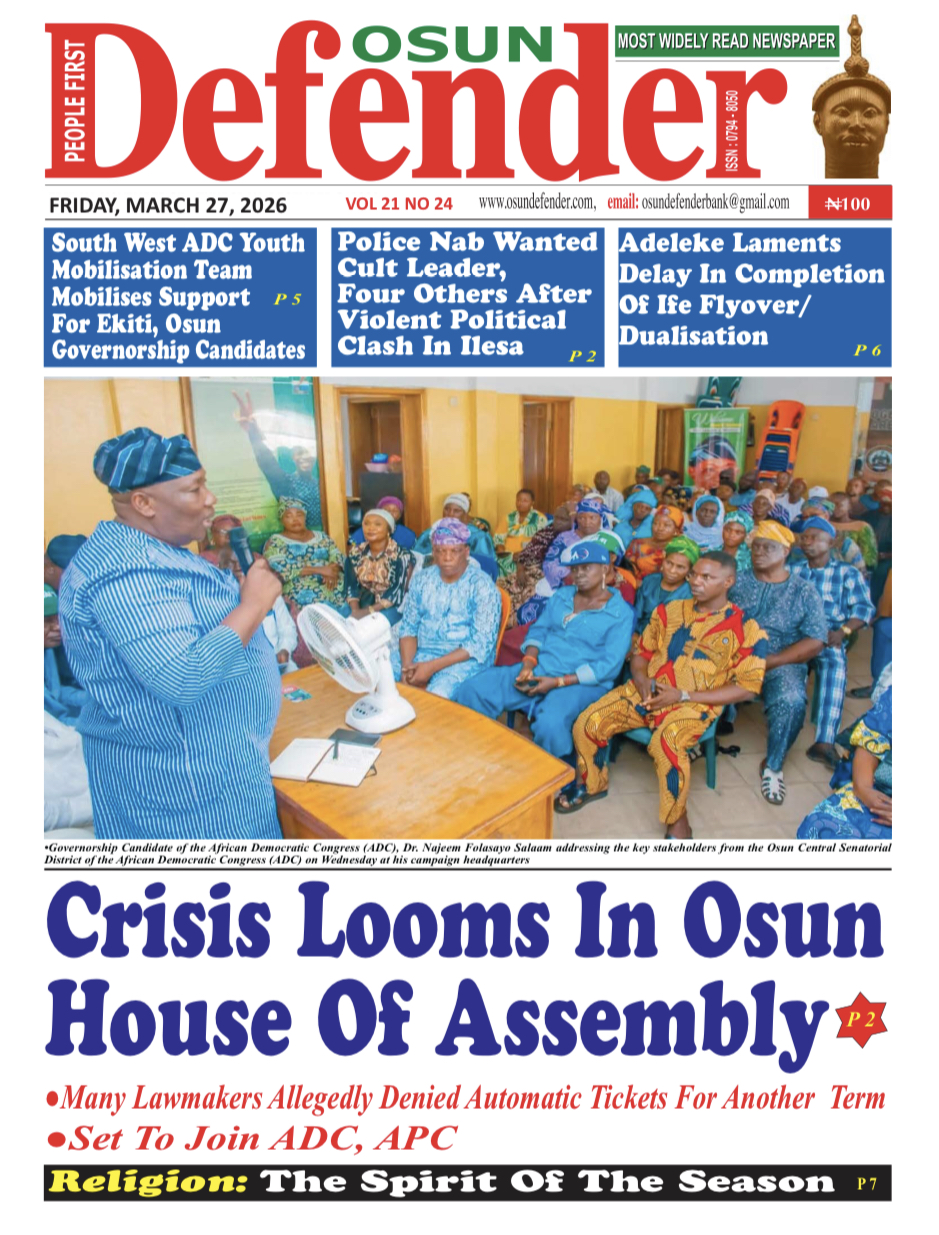
In every democratic society, political maturity is not measured by the loudness of one’s allegiance but by the quality of one’s judgment. As Osun State approaches another gubernatorial election cycle, the conversation should rise above familiar chants and entrenched loyalties. It is within this context that supporting the African Democratic Congress (ADC) deserves to be understood not merely as a political choice, but as a statement about political maturity.
For too long, politics in our space has been shaped by habit rather than thought. Many voters inherit party loyalty the same way they inherit family names—unquestioned, unexamined, and often unchallenged by performance. This culture has weakened accountability and reduced governance to a contest of symbols instead of ideas. Political maturity begins when citizens pause to ask harder questions: What does this party stand for? What solutions does it offer? And how does it plan to improve the everyday lives of the people?
The ADC presents itself as a response to this very fatigue. Its growing relevance lies not in noisy rhetoric, but in its insistence that politics must return to principles—internal democracy, transparency, inclusion, and service. Supporting such a platform signals a willingness to think beyond dominance by a few familiar parties and to accept that democracy thrives when alternatives are taken seriously. In mature democracies, strong third forces are not dismissed; they are studied, debated, and sometimes embraced.
Political maturity also means separating governance from personality worship. In Osun, as in many parts of the country, political discussions often revolve around individuals rather than institutions. This tendency encourages blind loyalty and excuses poor performance. The ADC’s appeal, however, is largely institutional. It invites citizens to evaluate structures, policies, and long-term vision rather than charisma alone. Choosing such a party is an acknowledgment that sustainable development depends on systems that outlive individual office holders.
Another marker of political maturity is the rejection of politics as warfare. Elections are not battles between enemies but competitions among ideas. The ADC’s posture, nationally and locally, has consistently emphasized issue-based engagement over insults and intimidation. Supporting a party that values civility in political discourse is a conscious stand against the politics of bitterness that has left many citizens disillusioned and disengaged.
Osun State, with its rich history of progressive thought and civic awareness, is well positioned for this kind of shift. From education reforms to public sector accountability, the state has often served as a testing ground for new political ideas. Supporting ADC aligns with this tradition of thoughtful experimentation. It reflects confidence in the electorate’s ability to weigh options carefully rather than default to the familiar.
There is also a generational dimension to this conversation. Many young voters today are politically aware but skeptical. They are less interested in party labels and more concerned with outcomes—jobs, security, infrastructure, and dignity of life. When such voters support ADC, they are not rejecting politics; they are redefining it. They are asserting that loyalty must be earned through performance and clarity of purpose, not demanded through sentiment.
Critics often label support for alternative parties as idealistic or wasted. Yet history shows that every major political transformation begins with a minority willing to think differently. Political maturity involves the courage to stand by conviction even when it is not the most convenient choice. It is the understanding that democracy is weakened when citizens limit themselves to two options, regardless of results.
Ultimately, supporting ADC is not a declaration of perfection. No party is flawless. Rather, it is an affirmation of values—critical thinking over conformity, ideas over noise, and accountability over entitlement. It says that the voter is engaged, informed, and prepared to hold power to account, regardless of who holds it.
As Osun looks toward the future, the quality of our democracy will depend on the quality of our choices. Supporting ADC, in this light, is not just about winning an election.
It is about raising the standard of political engagement in the state. And that, perhaps, is the clearest expression of political maturity.
The opinions expressed in this publication are solely those of the author. It does not represent the editorial position or opinion of OSUN DEFENDER.
Related posts:
 Jonathan’s 2015 Election Concession Exemplifies Maturity In Politics, Says Council
 [PERSPECTIVE] ADC’s Recognition: A Turning Point For Opposition Politics In Osun
 PERSPECTIVE: The Political Portmanteau Of Osinbajo/Tinubu: What Betrayal?
 [PERSPECTIVE] From APC To ADC: Aregbesola’s Strategic Shift And Its Implications For Osun Politics