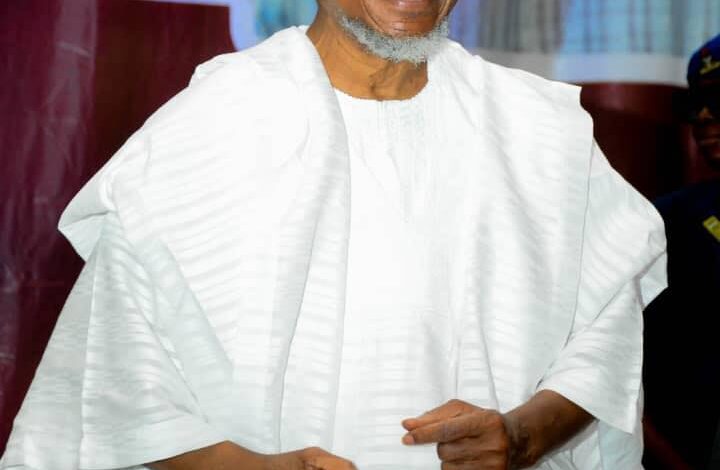

A United Nations official and rights advocate, Mr Olufemi Aduwo, has faulted recent claims that the former Minister of Interior, Ogbeni Rauf Aregbesola, betrayed President Bola Tinubu, insisting that the ex-governor’s political rise was not solely dependent on the President’s support.
Aduwo, who serves as the Permanent Representative of the Centre for Convention on Democratic Integrity (CCDI) to the United Nations and doubles as President of the Rights Monitoring Group, made this known in an open letter addressed to Comrade Olushola Matthew on Monday.
Matthew had earlier accused Aregbesola of betraying Tinubu in a widely circulated letter titled A Tale of Betrayer and Broken Loyalty, wherein he claimed Aregbesola’s political relevance was entirely tied to the goodwill of Tinubu, whom he accused the former minister of undermining through silence and indirect support for Tinubu’s critics.
But responding in a letter titled In Defence of Ogbeni Rauf Aregbesola – A Legacy Beyond Servitude, dated 27 May 2025, Aduwo described the accusations as emotionally charged and historically misleading.
He stated, “While you write with palpable emotion, what you portray as ‘betrayal’ is, in fact, the dignified assertion of political independence—a liberty to which every statesman is entitled, particularly one of Ogbeni’s stature.”
According to Aduwo, Aregbesola’s contributions to governance and development both in Lagos and Osun states cannot be dismissed or reduced to the product of political patronage.
He said, “Ogbeni Rauf Aregbesola is no political footnote. He is a distinguished public administrator whose pedigree in governance and grassroots mobilisation transcends the shadow of any political benefactor.
“To reduce his monumental contributions to the benevolence of a single individual is not only historically disingenuous but also politically reductive.”
While acknowledging Tinubu’s role in Aregbesola’s emergence, Aduwo emphasised that political mentorship should not translate into lifelong servitude.
“Yes, Asiwaju Bola Ahmed Tinubu played a significant role in Aregbesola’s political journey, as he has for many others. But let us not pretend that loyalty must equate to servility. The noble idea of political mentorship is not meant to reduce a mentee into an appendage, devoid of his own conscience or critical reasoning,” he wrote.
He also argued that the notion of betrayal ignores the natural evolution of political figures who eventually carve independent paths guided by personal convictions.
“What you interpret as ‘ingratitude’ is, in truth, the inevitable evolution of a political actor who has chosen to pursue ideals beyond the narrow confines of fealty,” Aduwo added.
He maintained that Aregbesola’s silence in recent political matters should not be misconstrued as complicity or disloyalty, but as a demonstration of maturity and principle.
“Is it truly betrayal when a man refuses to endorse the actions or direction of a benefactor he no longer recognises in principle? Or is it a mark of integrity that he does not cloak his convictions for the sake of convenience?” he queried.
Aduwo further claimed that Aregbesola himself had suffered political abandonment, yet chose the “higher path” by moving on without public bitterness.
He concluded that history would judge Aregbesola not as a man who betrayed his political mentor but as one who rose with “sweat and substance” and governed with “reformist zeal”.

Sodiq Lawal is a passionate and dedicated journalist with a knack for uncovering captivating stories in the bustling metropolis of Osun State and Nigeria at large. He has a versatile reporting style, covering a wide range of topics, from politics , campus, and social issues to arts and culture, seeking impact in all facets of the society.
Related posts:
 2019: Govs Alone Can’t Endorse Buhari- Tinubu and Other Newspaper Headlines Today
 Fufeyin Counters Self, Says Church Not Selling Miracle Water, Soap
 Tiinubu Presidency Falsely Claims Nigeria 4th In Global Economic Growth, IMF Ranks It 37th
 N585m Project Fund: AGF Counters Betta Edu, Says Minister’s Request Was Not Carried Out