‘Who Stole 2% Of Nigeria’s GDP?’ Atiku Asks Tinubu, Demands Accountability
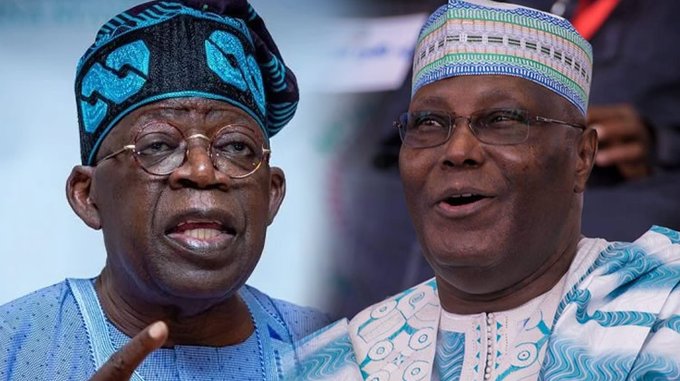


The presidential candidate of the African Democratic Congress (ADC), Atiku Abubakar, has challenged President Bola Tinubu’s administration to account for what he described as the “missing two per cent of Nigeria’s Gross Domestic Product (GDP).”
This follows a recent disclosure by the International Monetary Fund (IMF) that public expenditure equivalent to that amount was omitted from the country’s budget.
Atiku, in a statement issued on Saturday by his Senior Special Assistant on Public Communication, Phrank Shaibu, said the IMF’s revelation, coupled with the controversy surrounding the alleged Presidential Foreign Intervention Promotion Council (PFIPC), points to what he called a disturbing pattern of institutional corruption within the federal government.
According to him, the omission of such a significant expenditure from the national budget raises constitutional, legal and moral questions that require immediate answers.
“The Constitution is not a book of suggestions. Section 80 is unequivocal: no money shall be withdrawn from the Consolidated Revenue Fund except in the manner prescribed by the National Assembly. Budgetary appropriation is not a ceremonial exercise; it is the legal authority upon which every kobo of public expenditure rests.
“If, as the IMF has revealed, expenditure amounting to two per cent of Nigeria’s GDP was omitted from the budget process, then Nigerians are entitled to one simple question: Who stole the missing two percent of our GDP?,” he asked
“This is no longer an accounting discrepancy. It is a constitutional, legal and moral scandal. Money does not simply disappear from a national budget. Somebody authorised it. Somebody approved it. Somebody spent it. Somebody benefited from it. Nigerians deserve to know who those people are.”
The former Vice President argued that the IMF’s findings reinforce concerns that the PFIPC controversy was not an isolated incident but part of a broader pattern of abuse in the management of public funds.
He said, “The discovery that a fictitious agency found its way into official government processes and budgetary allocations should alarm every patriotic Nigerian. Now, the IMF tells us that expenditure equivalent to two per cent of our GDP was kept outside the budget. These are not disconnected events. Together, they point to a dangerous culture of institutional corruption.”
Atiku further alleged that the government’s spending priorities reflected what he described as institutionalised corruption.
“The evidence of this institutional corruption is already staring Nigerians in the face. While the Federal Ministry of Health reportedly received only ₦36 million in releases for critical health interventions despite a budgetary appropriation of over ₦218 billion, the so-called Presidential Foreign Intervention Promotion Council—a fictitious agency the Presidency now claims never existed—was reportedly allocated about ₦1.3 billion.
“Nothing better illustrates the warped priorities of this administration than a government that starves hospitals and healthcare programmes of funds while ghost agencies somehow find billions waiting for them. This is not fiscal management; it is institutionalised corruption.”
The ADC presidential candidate also maintained that no government agency could have operated with official recognition without approval from the highest levels of government.
“The Office of the Secretary to the Government of the Federation does not receive, acknowledge, process official correspondence or allocate office accommodation to any agency without the requisite approvals from the Presidency.
“Those now attempting to distance themselves from the scandal should stop insulting the intelligence of Nigerians.”
He called on the Secretary to the Government of the Federation, Senator George Akume, to publicly explain the circumstances surrounding the recognition of the PFIPC.
“The Secretary to the Government of the Federation, Senator George Akume, owes Nigerians a duty of candour. He must come clean. The country deserves to know who authorised the recognition of the so-called Presidential Foreign Intervention Promotion Council and under whose directive government institutions accorded it official status.”
Atiku also linked the controversy to what he described as unresolved questions surrounding President Tinubu’s public record.
“If President Tinubu had confronted openly and transparently the longstanding public controversies surrounding his identity, educational records, family background and the forfeiture of funds in the United States, instead of allowing those issues to linger unresolved in the public space, perhaps—just perhaps—the Adeniyis of this world and their collaborators within the corridors of power would never have felt emboldened to perpetrate a scam of this magnitude.
“Leadership is not merely about occupying office; it is about exercising the moral authority to enforce accountability. When questions of accountability remain unresolved at the very top, they inevitably weaken the culture of accountability throughout the system and embolden those who believe public institutions can be manipulated for private gain.”
The former Vice President also referenced allegations made by Prince Adeniyi Adeyemi, the alleged promoter of the PFIPC, who claimed that the dispute surrounding the agency escalated after he refused to pay a 48 per cent kickback on a proposed ₦27.3 billion take-off grant.
Atiku insisted that the allegation warrants an independent investigation.
“It is even more disturbing that the principal actor in this scandal, Prince Adeniyi Adeyemi, has publicly alleged that the dispute escalated after he refused a demand for a 48 per cent kickback from the Office of the Chief of Staff on the agency’s proposed ₦27.3 billion take-off grant.
“These are grave allegations that cannot be dismissed with press releases or propaganda. They demand an immediate, transparent and independent investigation.
“If the allegations are false, let the government prove them through an open investigation. If they are true, then every official connected with this scandal, regardless of rank or office, must be removed immediately and handed over to the appropriate security agencies for prosecution. Nigerians deserve the truth, not official denials.”
He further lamented that Nigerians continue to endure economic hardship while the government struggles to account for public spending.
“It is both ironic and cruel that citizens are being asked to make endless sacrifices while government itself cannot transparently explain where enormous public resources have gone.
“This is exactly how confidence in government collapses. Fiscal credibility cannot coexist with secret spending. Transparency cannot survive where public expenditure disappears from official records.”
Atiku stressed that the matter goes beyond politics, urging anti-corruption agencies and the National Assembly to investigate the IMF’s findings.
“This is about constitutional governance. It is about whether Nigeria is still governed by law or by the discretion of a privileged few who believe public resources belong to them.
“The National Assembly cannot pretend not to have seen this revelation. The Auditor-General of the Federation, the Public Accounts Committees of both chambers, the Economic and Financial Crimes Commission, the Independent Corrupt Practices and Other Related Offences Commission and every institution charged with protecting the public purse have a constitutional obligation to establish the truth.”
He warned that democracy itself is at risk if constitutional safeguards over public finance are ignored.
“No administration should assume that because it controls the instruments of power, it also controls the truth. The books must be opened. Every naira must be traced. Every expenditure must be justified. Every official found culpable must be held accountable.
“The Tinubu administration came into office promising Renewed Hope. What Nigerians are witnessing instead is renewed secrecy, renewed impunity and renewed fiscal abuse.
“The question before the nation remains simple and unavoidable: Who stole the missing two per cent of Nigeria’s GDP? Until that question is honestly answered, every claim of transparency by this administration will ring hollow.”
The Presidency has yet to respond to Atiku’s latest allegations as of the time of filing this report.
Hafsoh Isiaq is a graduate of Linguistics. An avid writer committed to creative, high-quality research and news reportage. She has considerable experience in writing and reporting across a variety of platforms including print and online.