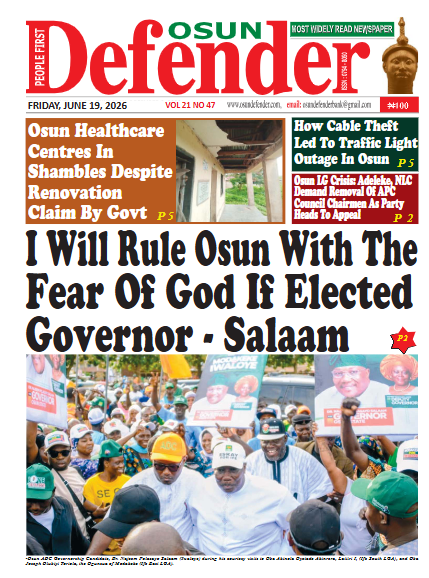
Why I Want To Be Governor Of Osun State – Najeem Salaam
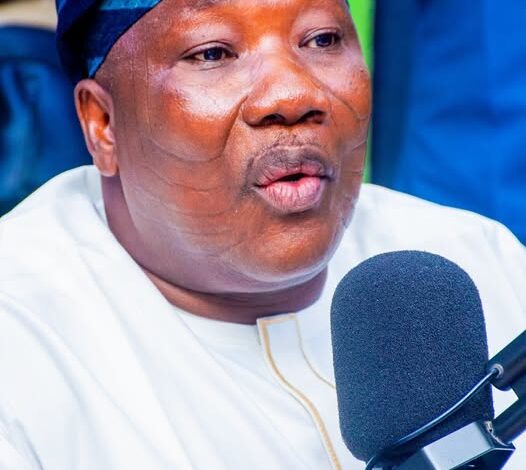


Rt Hon Najeem Folasayo Salaam holds a PhD in Political Science from the Obafemi Awolowo University (OAU) Ile-Ife. An experienced grassroot politician, Salaam had served as the Speaker, Osun State House of Assembly and currently the governorship candidate of the African Democratic Congress (ADC). Recently, he featured on a popular programme on a private radio station based in Osogbo, the Osun State capital, Rave FM where he explained his vision for the state and solicited for the support of the people of Osun State in the August 15 governorship election. Ibrahim Abdullahi captured the interview for Osun Defender. Excerpts:
Rt. Hon. Najeem Salaam, former Speaker of the Osun State House of Assembly and governorship candidate of the African Democratic Congress (ADC), has spoken extensively on Nigeria’s democracy, governance challenges, education reforms, internal party dynamics, and his ambition to govern Osun State.
Question: How do you assess Nigeria’s democracy since 1999, especially in relation to June 12, 1993?
Salaam: Thank you very much.
Let me begin from the foundation, because democracy itself is something we must constantly reflect on.
Democracy, as we all know, is the government of the people, by the people and for the people. Its essence is choice—the ability of citizens to freely select those who govern them without fear, intimidation, or manipulation.
Since 1999, Nigeria has had uninterrupted civilian rule, and that in itself is an achievement when compared to the years of military intervention. We now have regular elections for the presidency, governorship, national and state assemblies, and local government structures.
However, when we compare where we are now with the hope that came with the return to democracy, especially when we reflect on June 12, 1993, we see that there is still a gap.
The June 12 election, which was between late Moshood Kashimawo Olawale Abiola of the Social Democratic Party (SDP) and Bashir Tofa of the National Republican Convention (NRC) under the military administration of Ibrahim Babangida, remains widely regarded as the freest and fairest election in Nigeria’s history.
Why is it important? Because it reflected, more than any election before or after, the genuine will of the people.
Today, while we have improved structures and institutions, we still struggle with credibility issues, voter apathy, insecurity during elections, and the growing belief among citizens that votes may not always count.
So, democracy is still evolving, but we are not yet where we ought to be.
Question: Despite electoral reforms and technology, why is democracy still struggling to meet expectations?
Salaam: This is a very important question.
Yes, we have reforms. Yes, we have technology. Yes, we have improved electoral procedures compared to the past. But democracy is not only about technology—it is about trust.
The biggest challenge we have today is trust deficit between the electorates and the electoral process.
Many citizens go out to vote, but at the end of the process, they feel disconnected from the outcome. When that happens repeatedly, it creates apathy. People begin to ask: “Does my vote really count?”
Another serious issue is the monetisation of politics.
Today in Nigeria, politics has become extremely expensive. If you do not have financial power, even if you have capacity, integrity, and ideas, you may struggle to participate meaningfully.
That is not what democracy should be.
Democracy should be a competition of ideas, competence and vision and not a contest of who has more money.
We also cannot ignore insecurity. In some areas, voters are intimidated, and in some cases, elections are influenced by fear or violence. That alone weakens democratic participation.
So, while we are making progress in structure, we are still struggling in substance.
Question: Why are you contesting for governorship election in Osun State?
Salaam: My ambition is not about personal entitlement or occupation of office. It is about contribution and direction.
Political office is not permanent. It is not inherited. It belongs to the people.
The Constitution clearly allows any qualified citizen to contest elections, and I am simply exercising that right.
But beyond that, I am coming with a different orientation.
I often use a simple analogy: the Bible has the Old Testament and the New Testament. The Old does not mean bad, and the New does not mean rejection. It simply means renewal, progression, and evolution.
That is what I represent—the idea that governance must constantly renew itself with fresh thinking, new energy, and improved solutions.
So my ambition is rooted in offering new direction, not condemning the past.
Question: Why should Osun people choose you over other candidates?
Salaam: This is ultimately a decision for the electorates.
But I will say this clearly: leadership is not about slogans; it is about substance.
I have served as Speaker of the Osun State House of Assembly for eight years. That experience gave me deep exposure to governance, policy-making, oversight functions, and the internal workings of government.
The legislature is not a ceremonial arm—it is a critical pillar of governance. It shapes laws, checks the executive and represents the people directly.
So I come with institutional experience, but more importantly, I come with a structured manifesto.
My approach is simple: identify problems clearly and provide workable solutions.
Question: What are your key priorities if elected governor?
Salaam: My priorities are clear and focused.
First is electricity.
Without stable power supply, no economy can grow. If we can achieve near 24-hour electricity in Osun State, we will unlock industrial growth, small business expansion, job creation, and investment inflow.
Second is security.
No investor will come into an unsafe environment. Security is not optional—it is foundational.
Third is economic development through agriculture, technology, and internally generated revenue.
We must move from dependency to productivity. Osun must begin to create wealth internally.
If we get these three pillars right, development becomes inevitable.
Question: What is your education reform plan?
Salaam: Education is one of my strongest focus areas.
We need more qualified teachers in our secondary schools. Many schools are understaffed, and infrastructure in some cases is outdated.
We also need rehabilitation of dilapidated schools and improvement of learning environments.
But I must be honest—education reform is not something you complete in 100 days.
It is a continuous process.
What I can guarantee is that from day one, we will begin implementation.
We will begin recruitment planning, school assessments, and structured reform processes immediately.
We also have a broader plan for youth employment, including the creation of about 20,000 jobs across different sectors as part of economic stimulation.
Question: What is your position on the past salary policies like modulated salaries?
Salaam: Let me be very open on this.
As a leader, I accept responsibility for decisions taken while I was part of government.
We do not mean to hurt anybody.
There was a very difficult economic situation not only in Osun State but across several states in Nigeria at that period.
The modulated salary structure was not the best policy, I agree, but it was a survival decision under extreme financial pressure.
When revenue drops and obligations remain, governments are forced to make very difficult choices.
However, I sincerely regret any hardship experienced by workers during that period.
That is important for me to state clearly.
Question: Were there any positive outcomes during that period?
Salaam: Yes, and it is important that history is balanced.
During that time, there were also interventions in education and public service.
For example, over 6,000 teachers were recruited into permanent positions.
There were also welfare-related programmes, including school support initiatives and social interventions aimed at reducing hardship.
Unfortunately, public discourse often focuses only on the painful aspects and ignores the broader picture.
But I accept that leadership is judged holistically.
Question: Does that history affect your current political ambition?
Salaam: Politics is about perception, but also about ideas and truth.
I do not deny my roles in government history.
However, I am not defined only by the past. I am defined by what I am offering now and what I intend to do differently.
Governance is about learning, improving and correcting course.
That is what I represent today.
Question: How strong is ADC in Osun State?
Salaam: The ADC is very strong in Osun State.
We are not just participating in the election—we are competing to win it.
I know sometimes people judge based on public display or crowd size, but real politics goes beyond that.
What matters is structure, ideas and grassroots connection. And I can confidently say we are well positioned.
Question: There are concerns about internal party movements and defections. Is there a vacuum in ADC?
Salaam: There is absolutely no vacuum.
Politics is dynamic. People move, people retire, people return but the structure remains intact.
Leadership is not about one individual; it is about collective ideology and organization. Even when individuals step aside, the platform continues.
Question: Did you personally reach out to those who left or retired from active politics?
Salaam: Yes, engagements were made. Not only by me personally, but by members of the political structure. But again, politics is about freedom of association.
People are free to step back, return, or join other platforms. That is democracy.
Question: Do you feel weakened by such movements?
Salaam: No, I do not. In politics, individuals matter, but they do not determine destiny. What determines success is the strength of ideas, organization, and the people’s acceptance.
So I remain focused.
Question: What is your message on political violence in Osun State?
Salaam: I want to speak very clearly on this.
No political ambition is worth the life of any human being. Politics is about ideas, not guns. We are brothers and sisters first before politics. I appeal to all supporters and stakeholders to avoid violence.
Security agents must also be proactive. Democracy cannot thrive in an atmosphere of fear.
Question: what is your final message to the people of Osun State?
Salaam: My message is simple.
My manifesto is a contract with the people. We are offering electricity, security, education reform, job creation and economic transformation.
We are not promising perfection—we are promising commitment, direction, and structured progress.
At the end of the day, the decision belongs to the people. And I believe the people will choose wisely.