Yar’Adua Wrote Transmission Of Power Letter To Me, But His Aide Kept It – Jona
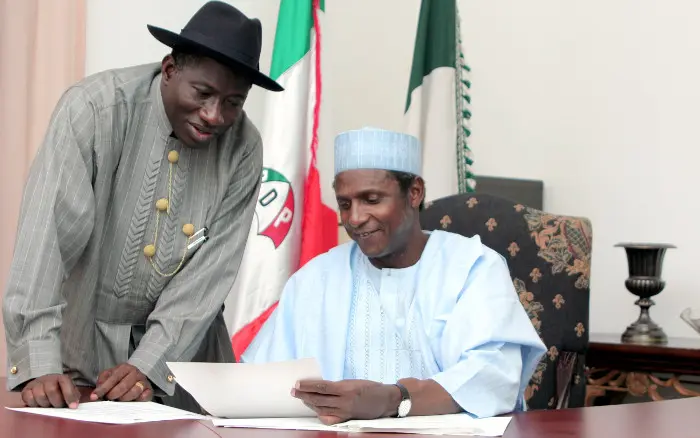


Former President Goodluck Jonathan has disclosed that the late President Umaru Musa Yar’Adua did indeed write a letter transferring presidential powers to him during his prolonged illness, but the said letter was never delivered to the National Assembly.
Jonathan made this revelation in an interview with the Rainbow Book Club while speaking on his memoir My Transition Hours.
He described the period as one of the most turbulent in Nigeria’s democratic journey, marred by ethnic and religious tensions, constitutional uncertainty, and widespread political anxiety.
According to the former President, although Yar’Adua had penned the letter, the individual entrusted with submitting it failed to do so, thereby creating a dangerous leadership vacuum.
“That letter was written. But the person who the letter was handed over to, I will not mention the name, refused to submit it to the National Assembly. Yar’Adua became so ill that he had no control of issues,” Jonathan stated.
He explained that the absence of a formal transfer of power plunged the country into a constitutional crisis, as he, then Vice President, could not legally assume the role of Commander-in-Chief.
“The President of Nigeria has two main responsibilities. First, you are the Chief Executive, like a Prime Minister that the Vice President can assume,” he said.
“But there was no Commander-in-Chief, and there’s nothing like Acting Commander-in-Chief. You are either a Commander-in-Chief or not.”
The uncertainty, he noted, created a tense political atmosphere across the nation, particularly given the north-south and Muslim-Christian divide. Jonathan acknowledged that Nigeria was on edge, with coup rumours becoming rampant.
“The country was tense. Under this north-south divide, Christian-Muslim divide, it was really tense. Every day I was hearing about coup,” he recounted.
He also revealed that some associates had advised him to vacate the State House over safety concerns, but he declined, opting to remain even at the risk of his life.
“I remember one day, I was still Vice President, they had not even moved the Doctrine of Necessity and some of my friends came and said, ‘No, you don’t have to sleep here. You have to come and sleep in my guest house,’” he said.
“I said, ‘No.’ I will stay in the State House. If anybody wants to kill me, it’s better you kill me in the State House so Nigerians will know that they assassinated me in the State House. They know I have not committed any offence. If I go and stay in your guest house and people kill me there, they will now say Indian girls brought apple to kill me. And I wouldn’t want that kind of story.”
Eventually, the National Assembly invoked the Doctrine of Necessity, allowing Jonathan to become Acting President.
Despite the uncertainties and growing political pressure, Jonathan said he remained calm and focused, refusing to be intimidated.
“To me, I was not bothered. Really, I was not bothered. And I was very calm. But that was the scenario,” he added.
Sodiq Lawal is a passionate and dedicated journalist with a knack for uncovering captivating stories in the bustling metropolis of Osun State and Nigeria at large. He has a versatile reporting style, covering a wide range of topics, from politics , campus, and social issues to arts and culture, seeking impact in all facets of the society.
Related posts:
 Today In History: Umar Musa Yar’Adua: Biography, Cause Of Death, Education, Family, Legacies, Net-Worth & More
 Former Nigerian Attorney General Adoke Implicates Obasanjo, Yar’Adua and Jonathan
 (Photo) Osinbajo Pays Courtesy Visit To Late President Musa Yar’Adua’s Mother
 I Turned Down Yar’Adua’s Ministerial Offer – Pat Utomi